

Five Days Later...
The final menu, the team that built it, and something coming tomorrow.

It’s Friday night. Five days out from the closing of República.
The first three nearly broke me.
I don’t know if it was the body giving out and taking the brain with it, or some version of the flu, or COVID — whatever is going around, it found me. Add to that the weight of everything I was already carrying, and you’ve got a perfect recipe for an existential crisis. The kind where you start thinking maybe life would be easier with a paycheck every two weeks. Maybe easier if I didn’t have to constantly think about how to change, how to innovate, how to create. Maybe easier as a cog somewhere. Somewhere quiet.
I won’t lie — the first two days, I let it take me. Wednesday, I didn’t know who I was. By Thursday, I was back. And today, I look at those two days and think: you let it really get to you, and that’s okay. Congratulations, you’re human. Now keep going.
So here are the three things I want you to take away from this last version of República.
One. The Menu.
The final menu was, collectively, the best we ever put out. I say that with full respect to every chef who came through our doors — the Lauros, the Lalos, the Juans, the Dannys, all of them, and the people who cooked alongside them. There will be a time for that conversation. But this menu was different. Dish by dish, it was a curated experience — not just the food itself, but the arc. The acidity, the heat, the texture, the movement from one course to the next. An orchestra. And the only reason it worked is because I had the right people around me to play it.
Two. The Team.
That menu only came together because of who built it. And that team was special — mostly because they believed. Back of house, I watched people run with things. I watched talent bloom in those final weeks. The feedback loop was tight: less of that, more of this, go back, change that — and everyone came back excited. That’s rare.
Front of house was a whole different story. There was a moment — briefly — where I thought it was going to be me, my brother, Olivia, and maybe Miguel running dishes to the end. Instead, what we got was one of the best front of house teams we’ve ever had. Heavy on storytelling. Steady under pressure. They rolled with it, every night.
If you were there and you got to experience it — thank you. You saw something real.
Three. What República Was.
This is the part where I have to be honest, even if it makes me sound like an asshole.
República is the best to ever do it. Not because of the food alone — though the food was extraordinary — but because of the intention behind every single piece of it. The stories that drove the dishes. The research. The discipline. The wine program built entirely around BIPOC, LGBTQ, and women producers at a time when nobody here had the guts to do that. The mezcal program, where I pulled the labels off the bottles so my team couldn’t default to a brand name — they had to know what they were pouring. Don Miguel Márquez carried that program and did it better than anyone else in this city.
That kind of intentionality doesn’t happen by accident. And it doesn’t get replicated easily.
There are people out there cooking good Mexican food right now. Some of the best ones came through our programs. They may not point the credit back, and I’m not asking them to. But without República existing, without the blueprint we laid down, the conversation in this town looks different. We both know it.
I’m not saying this to diminish anyone. I’m saying it because it’s true, and because I’ve earned the right to say it.
The bar in this city for what “Mexican” means is still low. What we built was never pedestrian. And now it’s on whoever comes next to decide how seriously they want to take this.
The Final Menu.
What follows is the last menu República ever served — from Course One through the final dessert. I’ll give you the context the way we gave it at the table.
Course One: Comida Ancestral
If you’ve never been to República, welcome.
If you have, you’ve probably heard this story before. And tonight, you’ll hear many more. We’ll talk about what’s on the plate, where it comes from, even the language behind it.
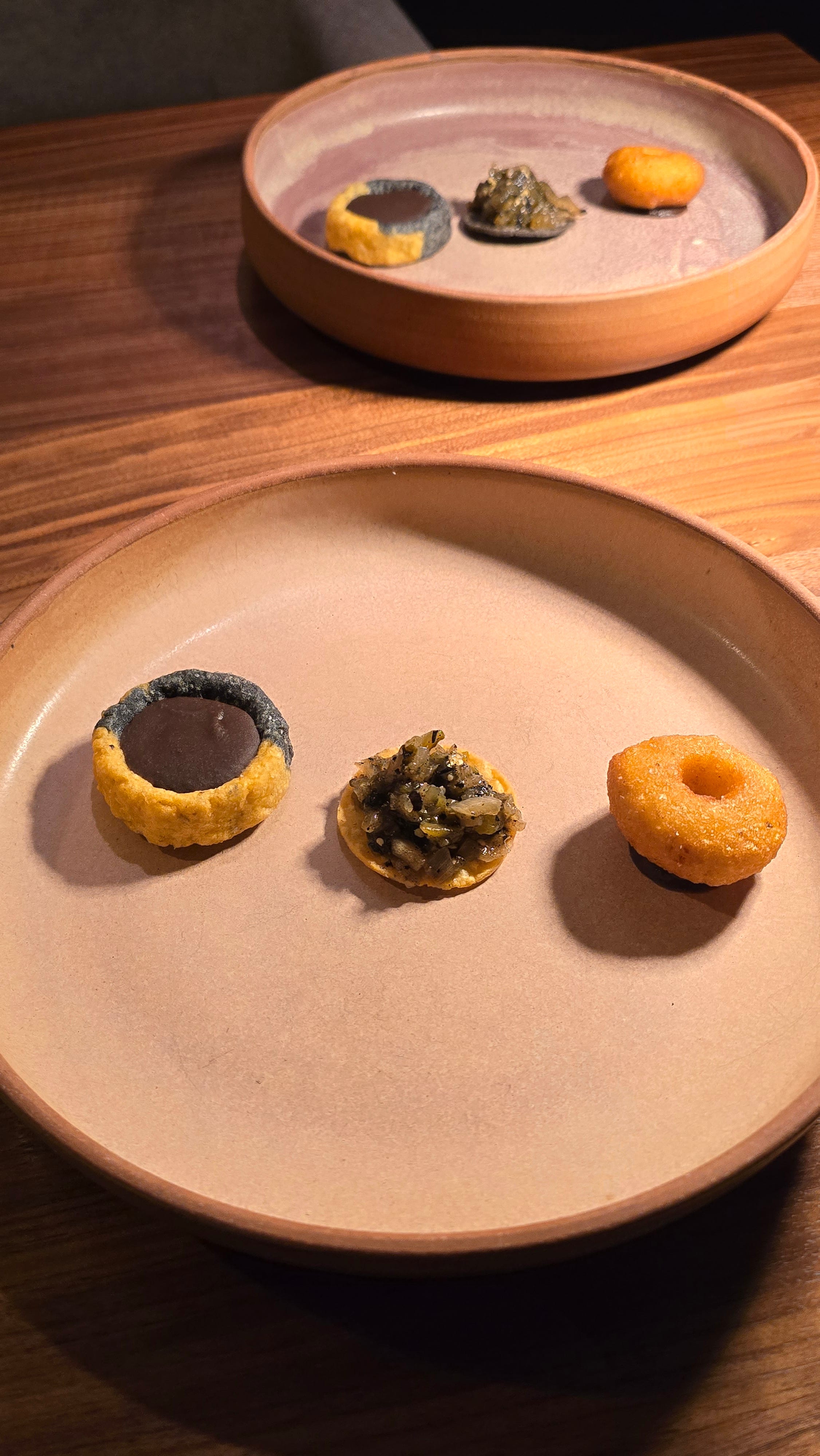
We begin with botanas; what we call our welcome. Everything you see here is native to this side of the world, prior to 1519. That was intentional. We wanted to show you what food looked like, and tasted like, before the arrival of Europeans. These are the things that would have been eaten here—maybe in larger portions, maybe more simply—but they would have been here.
What comes next in history is often framed one of two ways: as progress, or as a perversion. It depends on where you stand. Our goal tonight is to walk you through that tension, to offer small moments that explain why this cuisine is more than Mexican. It’s Mexico-forward. Because before it was Mexican, it was something else entirely. And now, it’s up to us to imagine what it can become.
In front of you: a sope, a totopo, and a chochoyote.
All three existed here before 1519, made with ingredients that existed here before 1519. Seven components; corn, potato, alliums, tomatillo, peppers, beans, avocado leaf.
This is our beginning.
Provecho.
Course 2: Japanese Cuisine
There was a moment in the early 1900s when Japanese immigrants began arriving in places like Ensenada, Mazatlan, Los Cabos, Puerto Vallarta, and along many other small fishing towns down the Pacific coast. They worked those waters quietly, steadily, building lives in the industry.
Then World War II happened.
Mexico declared war on the Axis powers, and many Japanese families were removed from the coasts and relocated inland; Puebla, Jalisco, what is now Mexico City. Displacement, yes. But also exchange. They carried with them knife skills, a reverence for raw fish, a discipline around seasonality. And little by little, those techniques began to fold into the cuisine.
From that period you see the lineage of tiraditos, ceviches, aguachiles; the way we slice, the way we dress, the way acidity and heat are balanced. Even Japanese Americans who made their way into Mexico during and after the war contributed to that spread.
The dish traveled. It adapted. It became ours.
With this dish, we honor that chapter.
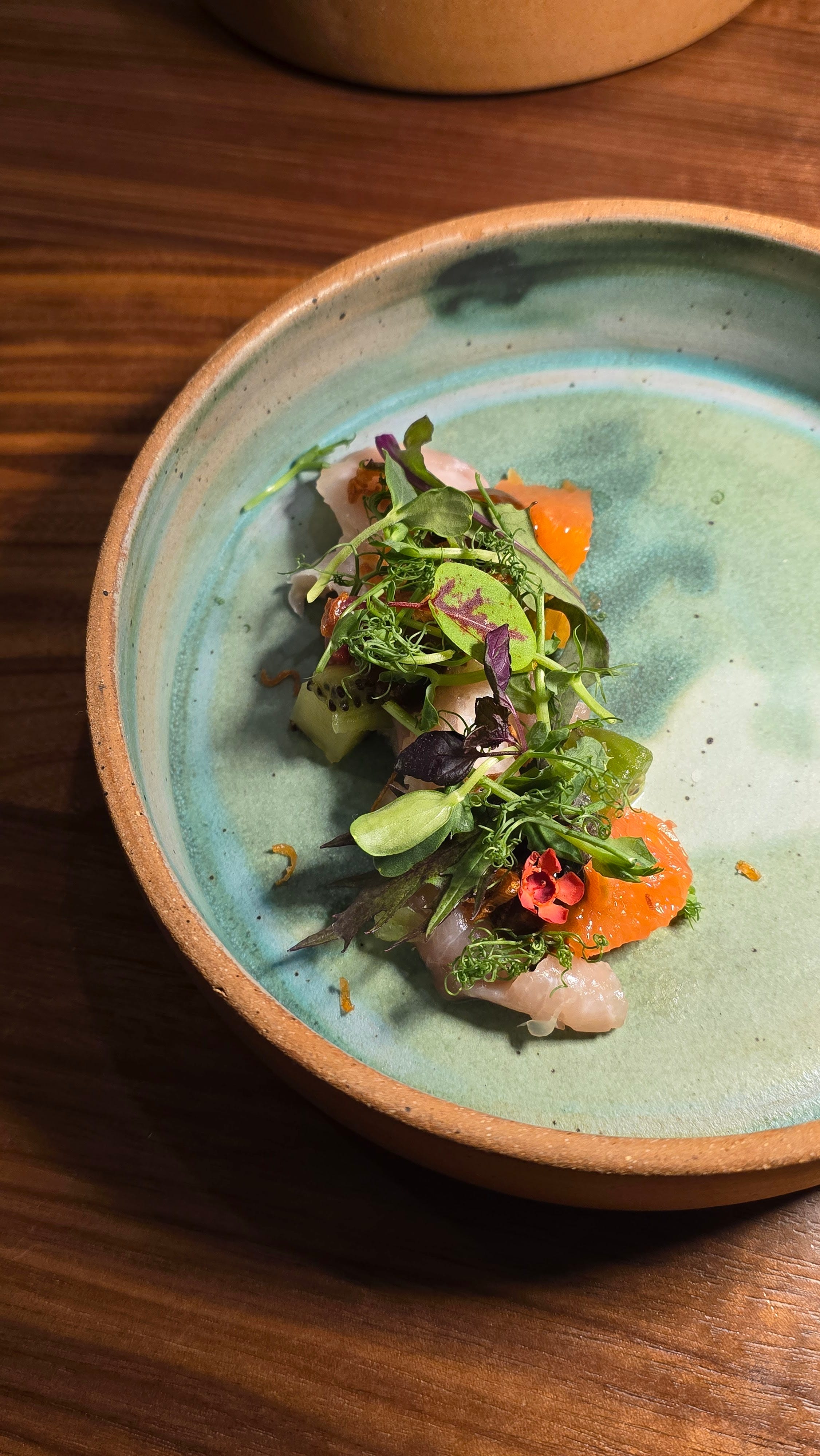
What you have in front of you is a reflection of that dialogue. Hamachi crudo — a nod to Japanese precision — dressed with oranges and kiwis at peak season, fried sunchoke for texture, and greens pulled from our garden.
In the center, a salsa negra built from black garlic, chile ancho, chile sandía, black garlic, and soy sauce acting as the bridge; the binding agent that pulls Japan and Mexico into the same sentence.
Course 3: The Seasons
For your next course: The Season
The assignment was simple, source as much as you can on this plate from within 25 miles of where we are standing.
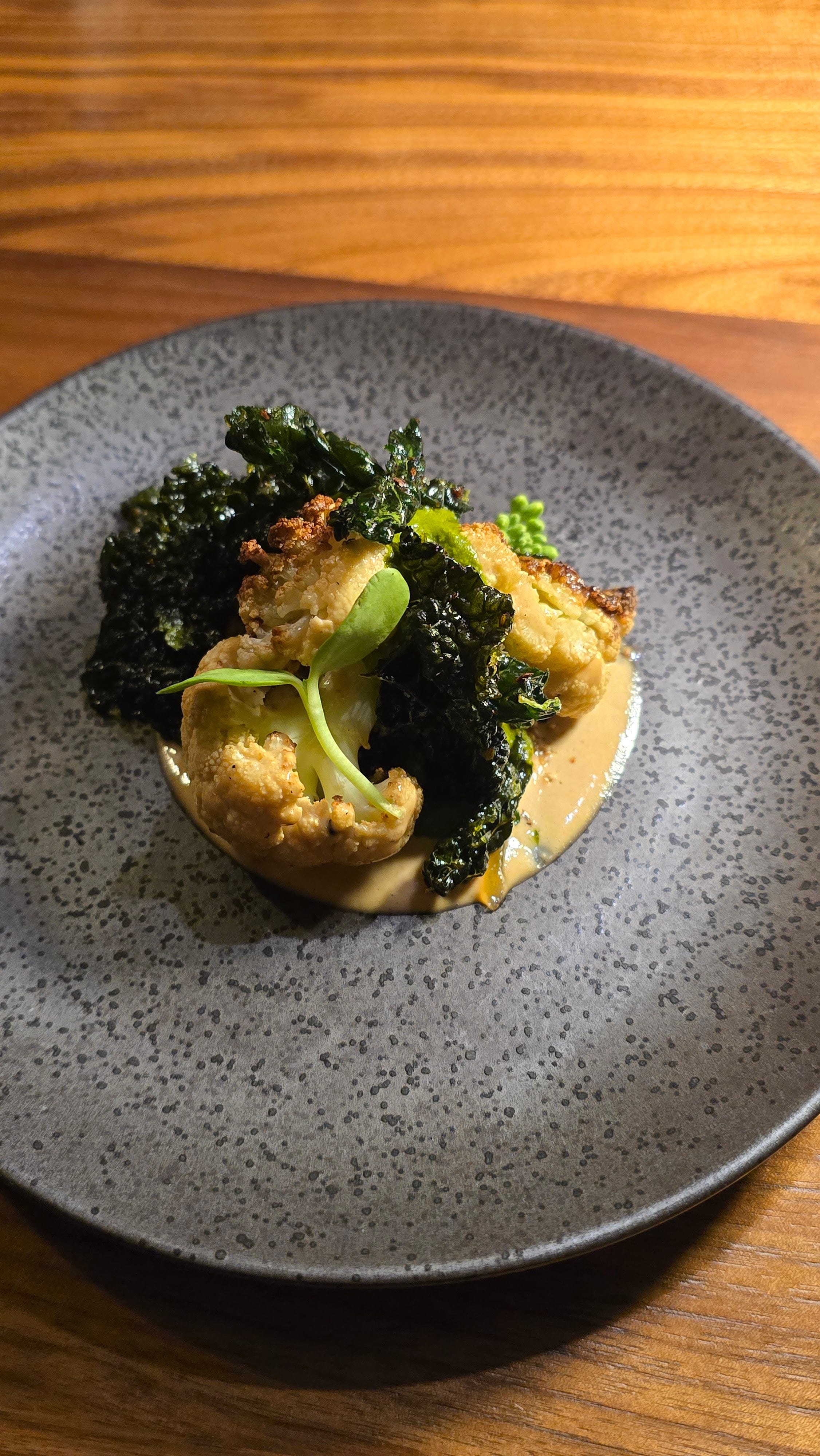
This is a deceptively simple dish for us, because it’s really about honoring the seasons. What you see is straightforward—cauliflower roasted, then finished in the oven right before service to bring out its sweetness and depth.
What transforms it is the sauce. Not quite a mole, but built with the same intention. It’s a green sauce composed of mostly brassica and olive oil, lemon juice and zest, a touch of mostarda, salt, and pepper. Clean. Bright. Purposeful.
Sunflower is the thread that ties the dish together. You’ll find it throughout—puffed amaranth, toasted sunflower seeds. Finished with fried dino kale.
. For such a small plate, there’s a lot happening.
But that’s the point.
This dish exists to honor two things: the season we’re in, and the seed; what sustains, what returns, what reminds us that good cooking doesn’t need excess. Just intention.
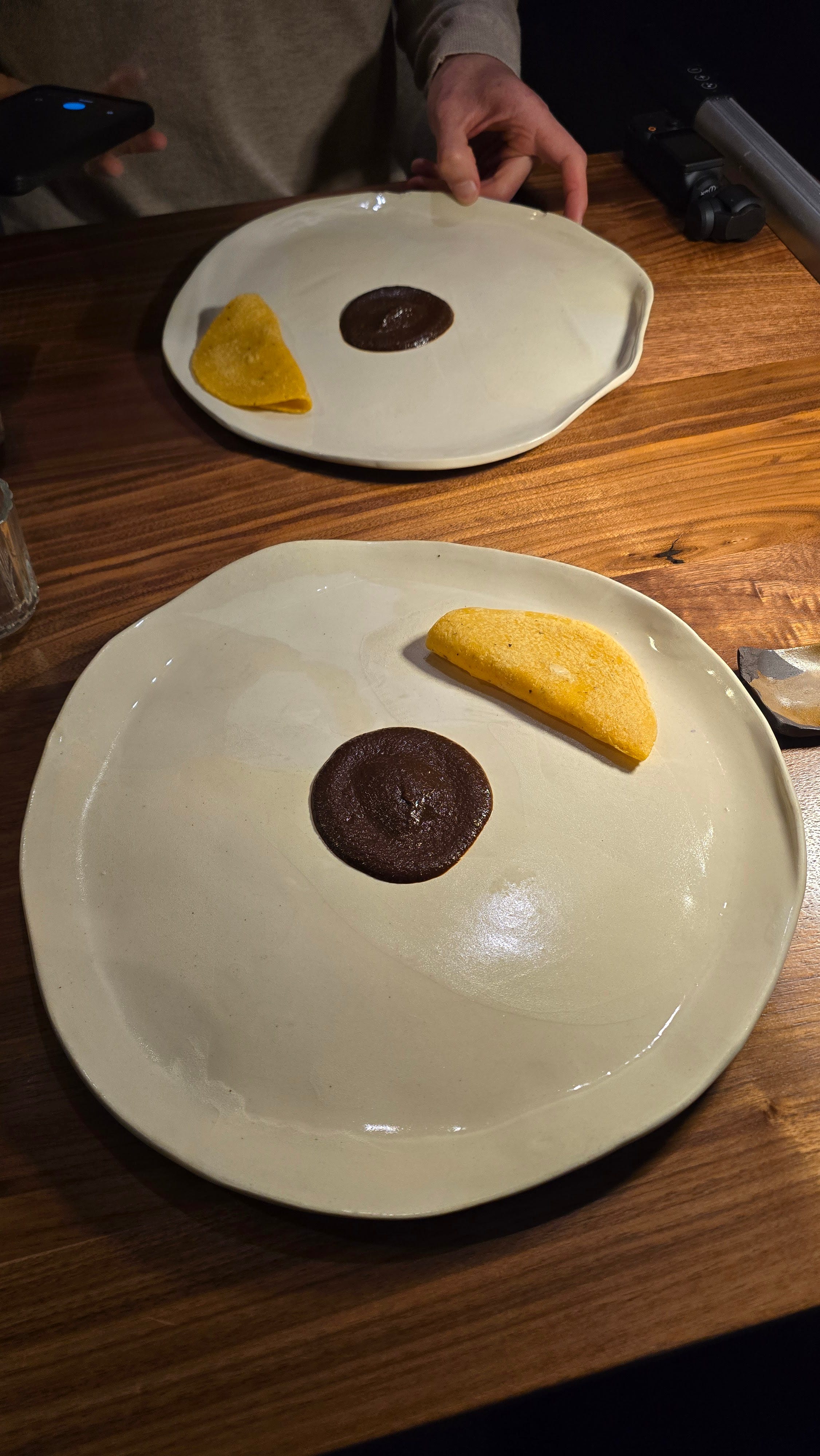
Entre medio—this is where we bring you a small bite between courses.
For many years, Mexican cuisine—especially in this country—had to be presented through cliché in order to be celebrated. You couldn’t just serve the food. You had to serve the whole performance: the sombreros, the sarapes, the music, the colors, the familiarity of sour cream and cheese. That became the version of Mexican food Americans learned to love.
Meanwhile, in Mexico, there was often far more simplicity.
In the fine-dining world, that simplicity was harder to take seriously. The food wasn’t considered refined unless it arrived with all the props. That changed because of Enrique Olvera. For us, he represents a turning point. He took a cuisine that many thought was predictable and showed that it could be fine dining; not just on the plate, but in the entire act of service.
He is the chef who serves exactly what you see here: a tortilla and mole—as a main course. No garnish. No explanation needed.
We could never do that here. First, because we could never do it justice. And second, because people still aren’t quite used to seeing it. So instead, we offer this as a gesture. A thank-you. To him, for giving us a blueprint. And to you, for supporting us, for keeping us in business, and for allowing us the freedom to create without fear of whether or not something will be accepted as “fine dining.”
What you have is simple: a tortilla and a bit of mole madre.
Simple things. Simple pleasures.
Course Four: Chinese Cuisine
In the late 1800s, thousands of Chinese migrants crossed the Pacific looking for work and survival. Many had already helped build railroads across the American West, but after the Chinese Exclusion Act closed the door to Chinese labor in the United States, many workers moved south.
Mexico, under Porfirio Díaz, was expanding its rail system and modern infrastructure. Chinese workers were recruited to help lay the tracks that would connect northern Mexico—cutting steel lines across Sonora, Baja California, and Chihuahua.
When the railroad work slowed, many of those workers stayed.
Some settled in the desert city of Mexicali, where irrigation canals had just begun transforming the barren valley into farmland. There, Chinese migrants opened restaurants and markets, slowly adapting their cooking to the ingredients around them.
Soy sauce met dried chiles.
Garlic and ginger met desert-grown vegetables.
Woks met Mexican braises.
From those kitchens emerged one of the earliest examples of true fusion cuisine in North America—Chinese-Mexican food.
This dish follows that journey.
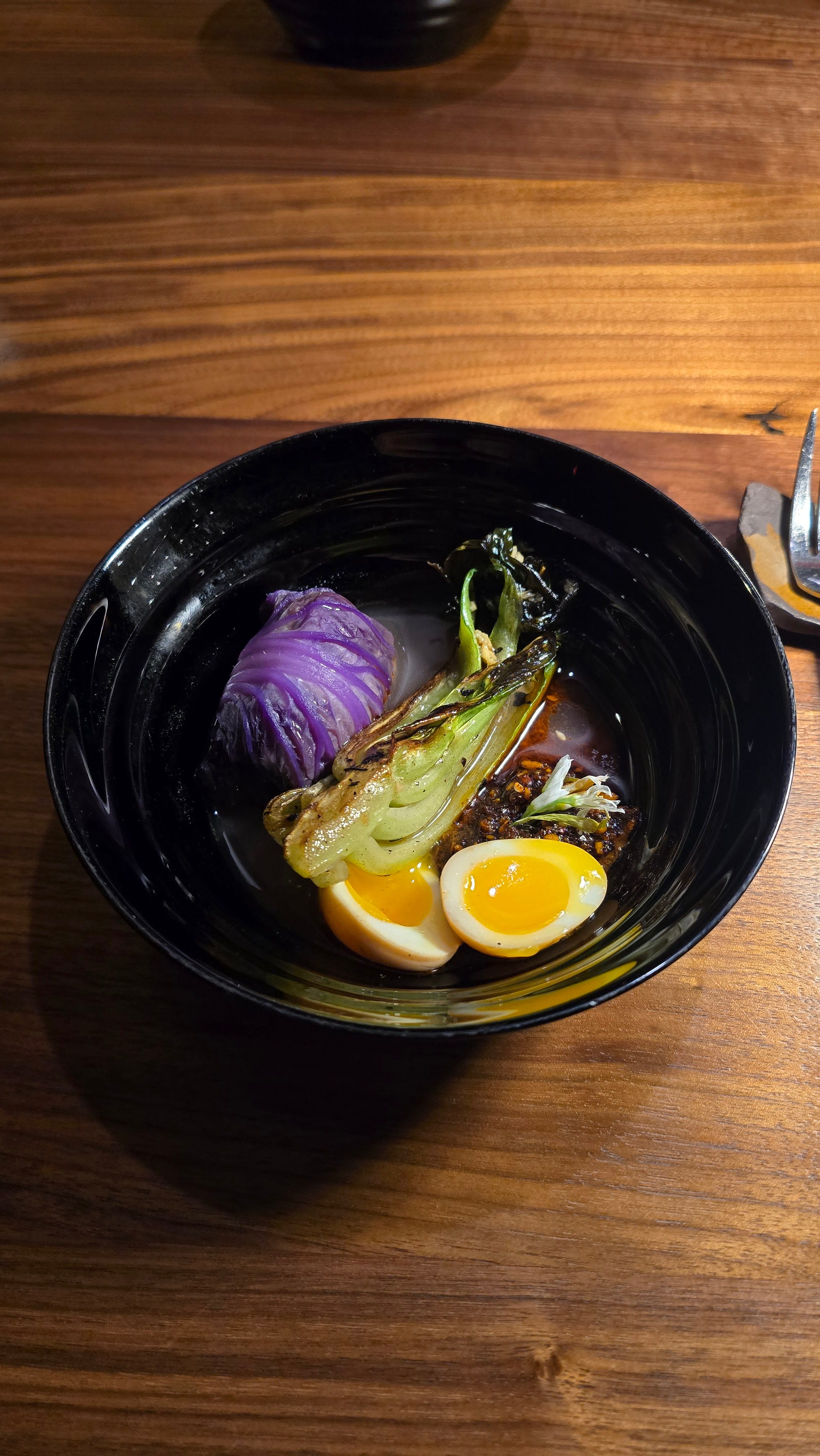
The short rib is braised in Chinese five spice and Mexican chiles—guajillo, chimayó, and sandía—echoing the moment when Chinese techniques met the dried chile traditions of northern Mexico.
It’s wrapped in a purple cabbage leaf, almost like a small parcel or bundle; something a railroad worker might carry with them on a long journey.
The baby bok choy, seared in garlic, ginger, and wine, nods to the cooking methods Chinese migrants brought with them across the Pacific.
The quail eggs, marinated in five spice and salsa negra, represent the culinary blending that began to define kitchens in Mexicali—where Mexican heat and Chinese aromatics began to share the same pot.
Finished with young mustard greens, the plate carries a balance of bitterness, spice, and warmth.
Like the railroads themselves, the dish connects two places that once seemed very far apart.
China and Mexico.
Two cuisines, meeting in the desert.
Course 5: French Cuisine
There’s a pivotal moment in the history of Mexican cuisine that spans just three years—1864 to 1867. It begins with the arrival of Maximilian I of Mexico and Carlota of Mexico, appointed by Napoleon III.
If you’ve ever visited Castillo de Chapultepec, you’ve seen the world they inhabited. They had a very specific taste, a very specific style. And while their rule was brief and complicated, what’s often overlooked is this: they genuinely admired Mexican ingredients and Mexican culture. They believed the cuisine deserved to be elevated, respected, and celebrated for its richness and complexity.
So they brought European gastronomy—specifically French technique—into the Mexican kitchen.
From that period forward, everything begins to shift. Carnitas as we know them. Pan dulce. Brioche and cakes. Stocks, sauces, and structure. French technique doesn’t replace Mexican food—it redirects it. It gives it new tools, new forms, a new vocabulary.
This dish is our reflection on that moment.
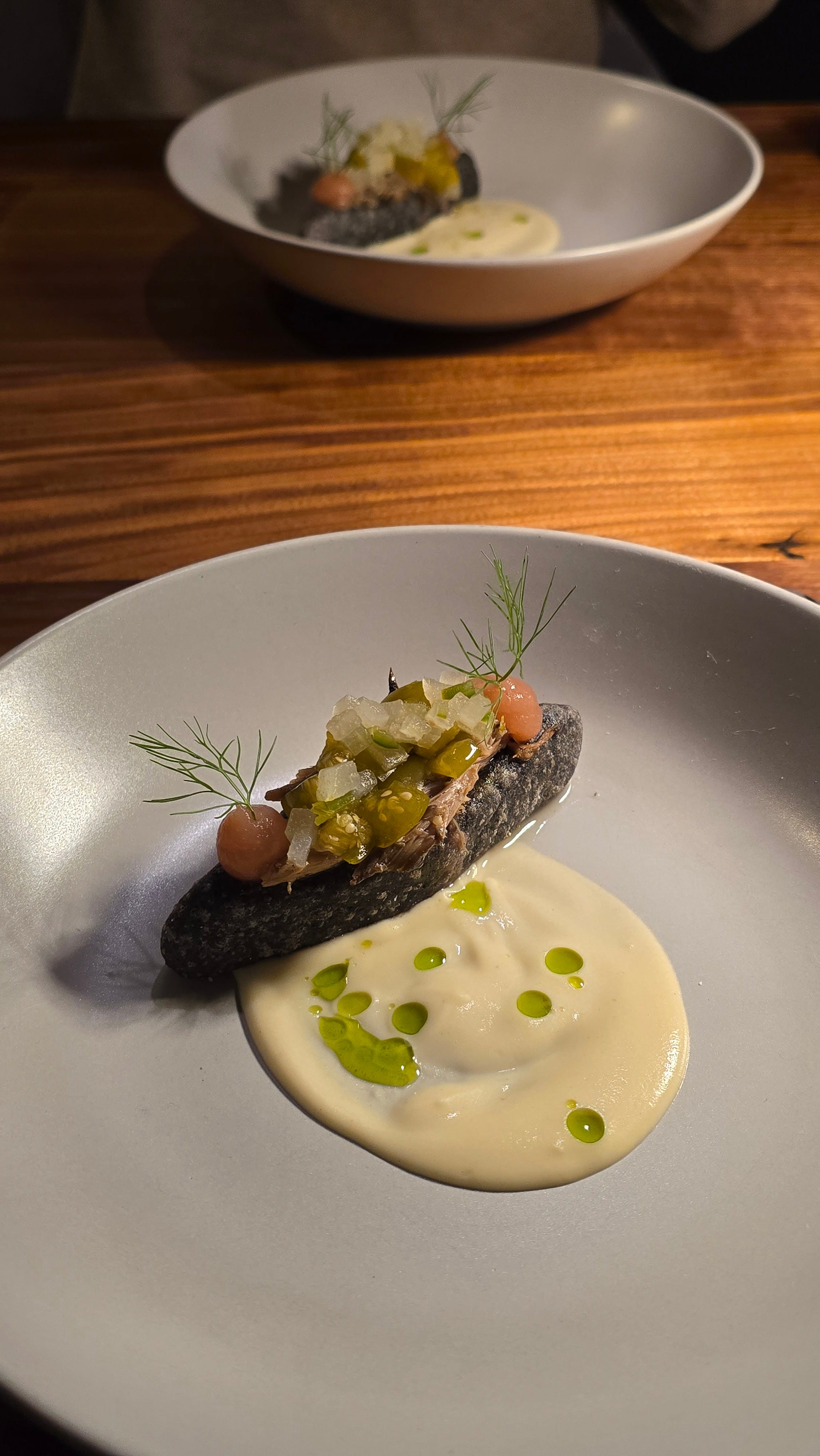
What you see is Chalupa Maximiliana—a small boat, or chalupa, also known in French as a chaloupe. At the base, an orange crema lacrasi—essentially a refined carrot soup. A tomatillo-serrano gastrique brings acidity and heat. Compressed apple and fennel add freshness. And the vessel itself is formed from corn—the one constant, the anchor.
The flavors may feel familiar. They may feel unexpected. But together, they should make sense.
This is our quiet homage—to that brief, influential moment, and to the collision of cultures that forever changed the direction of Mexican cuisine.
Course Six: The Evolution of our Cuisine
Mole de Frutas
Most people when they think of mole, they think of peanuts and chocolate sauce topeed off with sesame seeds. Truth is, there are over three hundred variations, just in Oaxaca alone, and even more ways of plating it. That’s the beauty of mole: when it’s done right, it reflects the season. It tells you exactly when you’re eating it.
This one does just that.
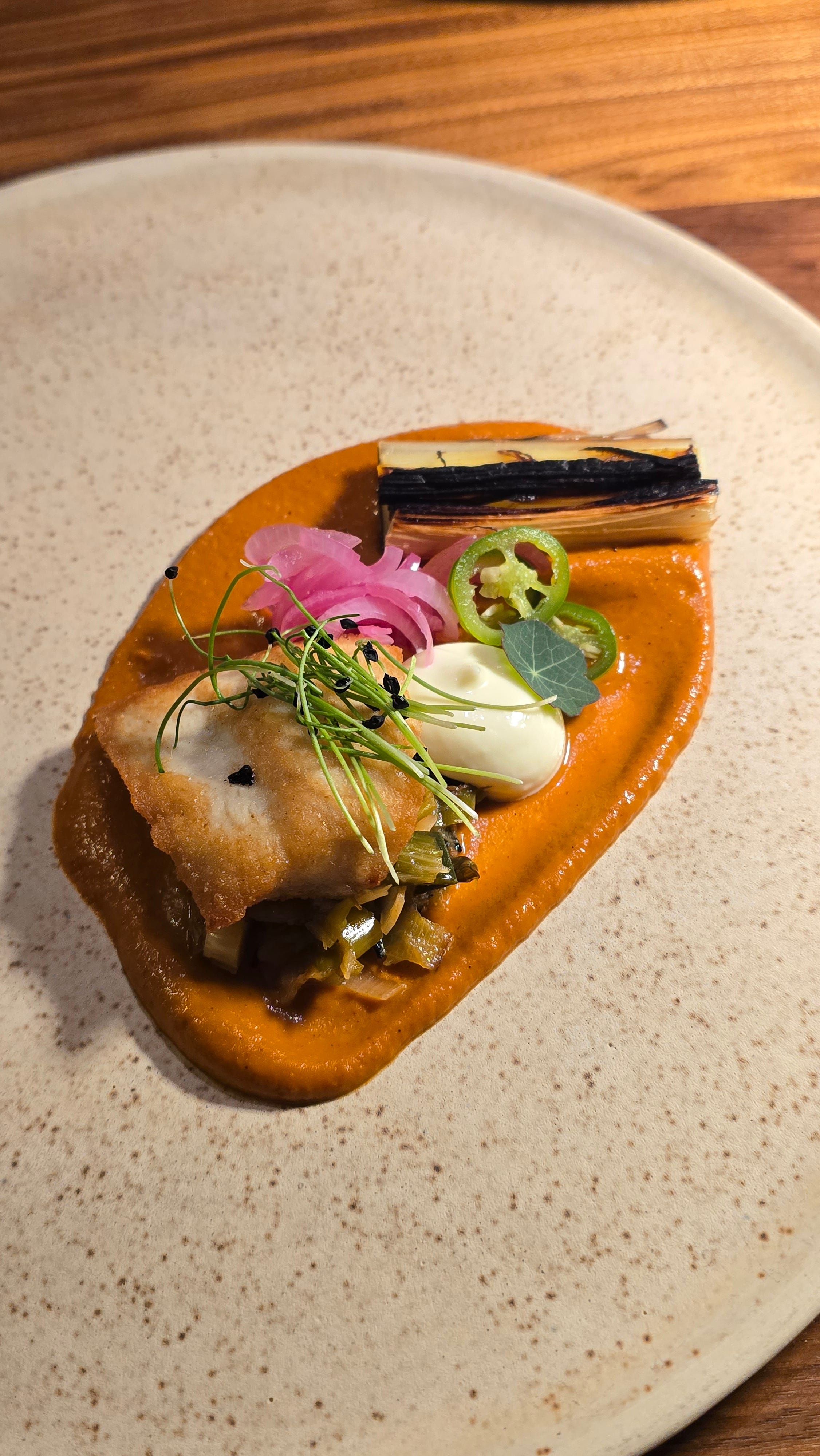
At its base are chile de agua and chile sandía—two peppers that are far from mainstream. They carry a natural sweetness, but also a quiet heat you should expect. From there, we build with fruit—apples and pears—which give this mole its lighter color and a softer, sweeter finish.
Once everything comes together, we let it rest. Then we return to it with a few final elements: toasted components, oranges, browned butter, even soy to give it a little more umamu. And then we wait. Mole doesn’t rush. It cooks until it’s ready.
When we are ready to plate we add the fish—a locally sourced sturgeon from Yakima. Alongside it, green leeks, flash-roasted for sweetness and depth. And to finish, a touch of mojo diablo, just enough to bring everything into focus.
This dish exists to honor the season—and to honor mole itself—served at the right moment, at the right time, at the very end of the meal.
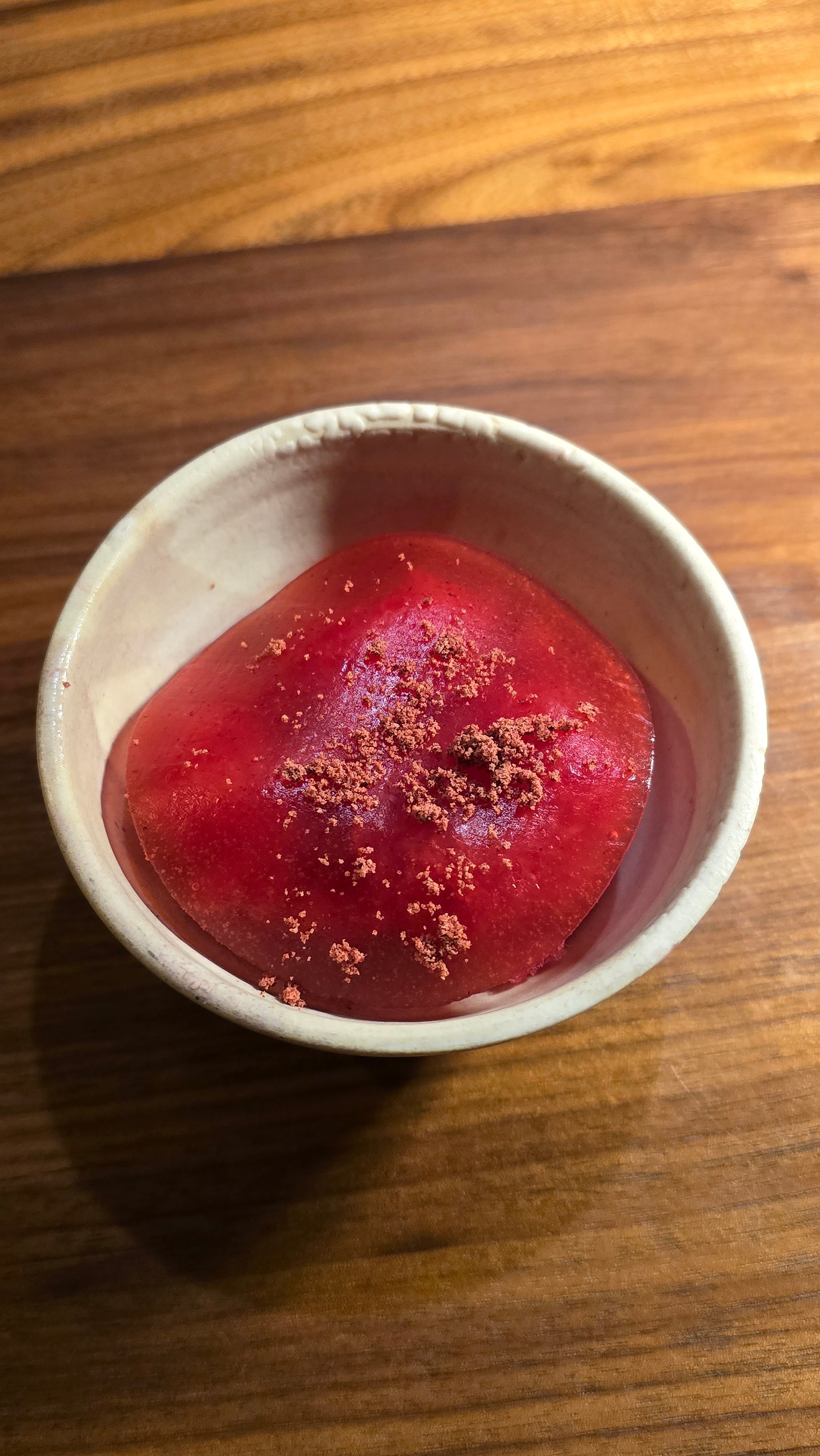
Palate Cleanser
The next course is our palate cleanser.
And this one is a classic.
If you grew up in Mexico, the Philippines, or really in many parts of the world where ice cream wasn’t always common, you probably remember some version of this—shaved ice, usually topped with brightly colored syrups or fruit flavors.
Simple, refreshing, and perfect for resetting the palate.
Tonight’s version keeps that spirit, but we’re using real ingredients rather than the artificial syrups many of us remember.
The ice is flavored with hibiscus, giving it that deep crimson color and a gentle tartness. Beneath it is a sumo mandarin and lemon curd, adding a little richness and citrus brightness.
And at the very top, there’s a small candied beet, just a touch of sweetness to round everything out and prepare you for the courses ahead.
A small moment of refreshment before we continue the story.
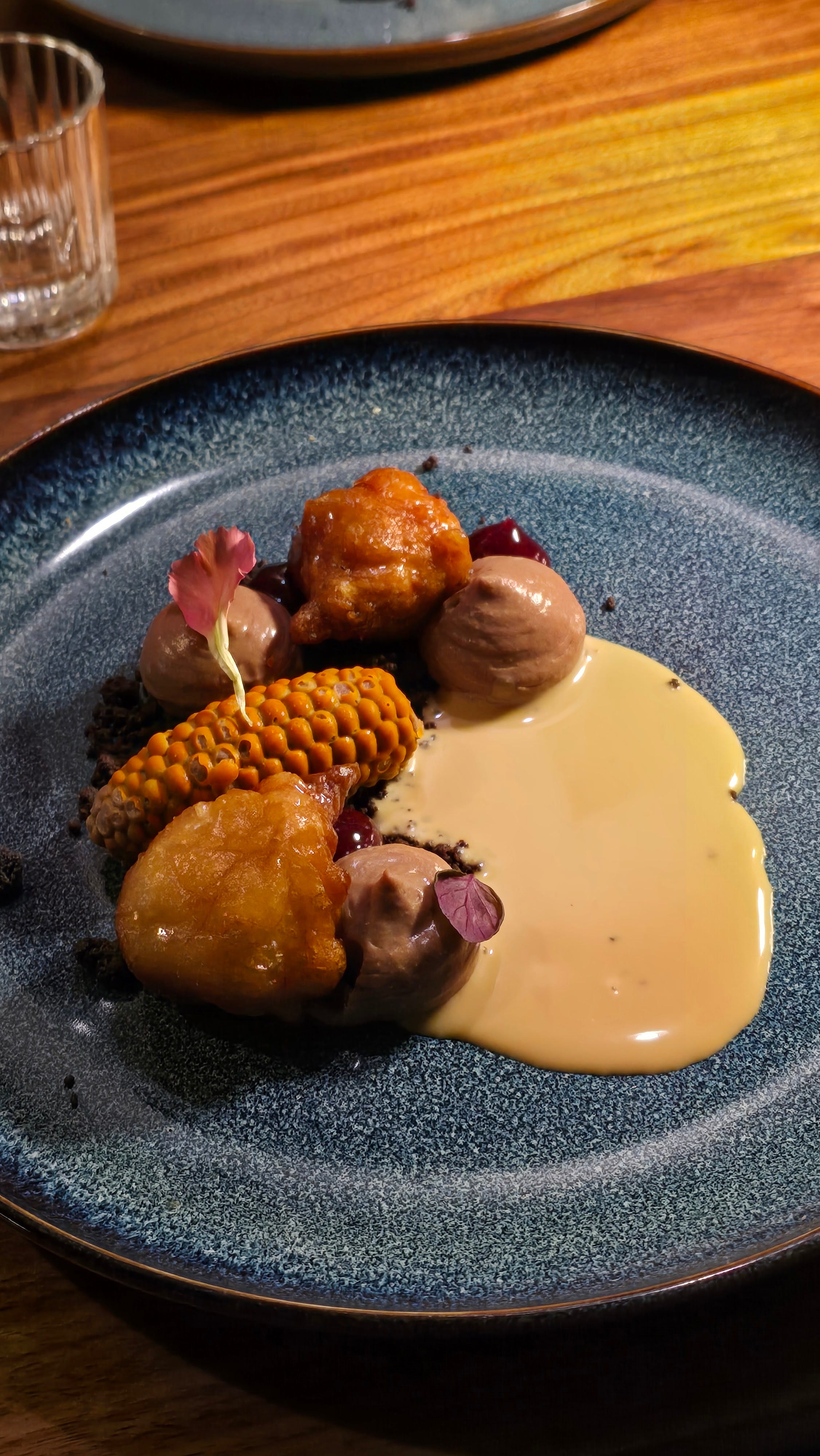
Final Course — Masa (dessert)
This final course brings us back to where the meal began.
Throughout this dinner, we’ve talked about ingredients that existed here long before many of the things we now associate with Mexican cuisine. One of the most important of those ingredients is masa.
So to close the meal, we return to it.
At the base is a pinole cocoa crumble—pinole being toasted and ground corn, something that has existed in Mexican cooking for centuries.
On top of that is a champurrado mousse. It’s intentionally very light on the chocolate, because we didn’t want this to become simply a chocolate mousse. Instead, it leans into the flavors of champurrado itself—our house-made masa, cinnamon milk, and dark chocolate.
Alongside it is a cinnamon-soaked doughnut, bringing a little warmth and softness to the plate.
That’s paired with a butterscotch cream infused with chile morita—just enough to give the dessert depth and complexity, but not enough to make it spicy or taste overtly of chiles.
And finally, we finish with a small gel to bring acidity and balance. Tonight that acidity might come from lemon curd, haskap berry—a wild Oregon berry similar to a blueberry that we preserved during peak season—or red verjus, depending on the version you receive.
A dessert that returns to corn, the ingredient that began this meal, and the ingredient that has been at the center of this cuisine for thousands of years.
One last thing, before I forget.
Tomorrow; Sunday — there’s a major announcement coming in the newsletter.
If you’re reading this, you’re probably a real one. You’ve been here, paying attention, sticking with us through all of it. And for that, I’m genuinely grateful.
For those who had the patience to follow along. For those who felt like they missed their moment. For those who thought maybe it was already over.
It’s not quite over yet.
Hang tight.
Big news tomorrow.