


It was the week before the week before.
Kelsey and I flew into San Francisco. Juanjo flew up separately, making his way from León to Mexico City, then Mexico City to SFO. We rented a car from Dollar, which meant standing in a line so long, disorganized, and spiritually punishing that it remains difficult to explain to anyone who wasn’t there.
The arrangement was that we would pick the car up at SFO and return it at the Sonoma airport. That was the trade: collect it from a shitty place, drop it off at the right one.
Eventually, we escaped and began our drive over to SF to pick up Juanjo who had arrived the night before. We found him in the Richmond, directly on our route to Sonoma. He was waiting at a coffee shop, camera already out.
Before I could grab a coffee and a cookie, Juanjo was loading the car. Then he was in the front seat, camera still in his hand.
Truth is, Juanjo is never really arriving anywhere. By the time you see him, he is already working.
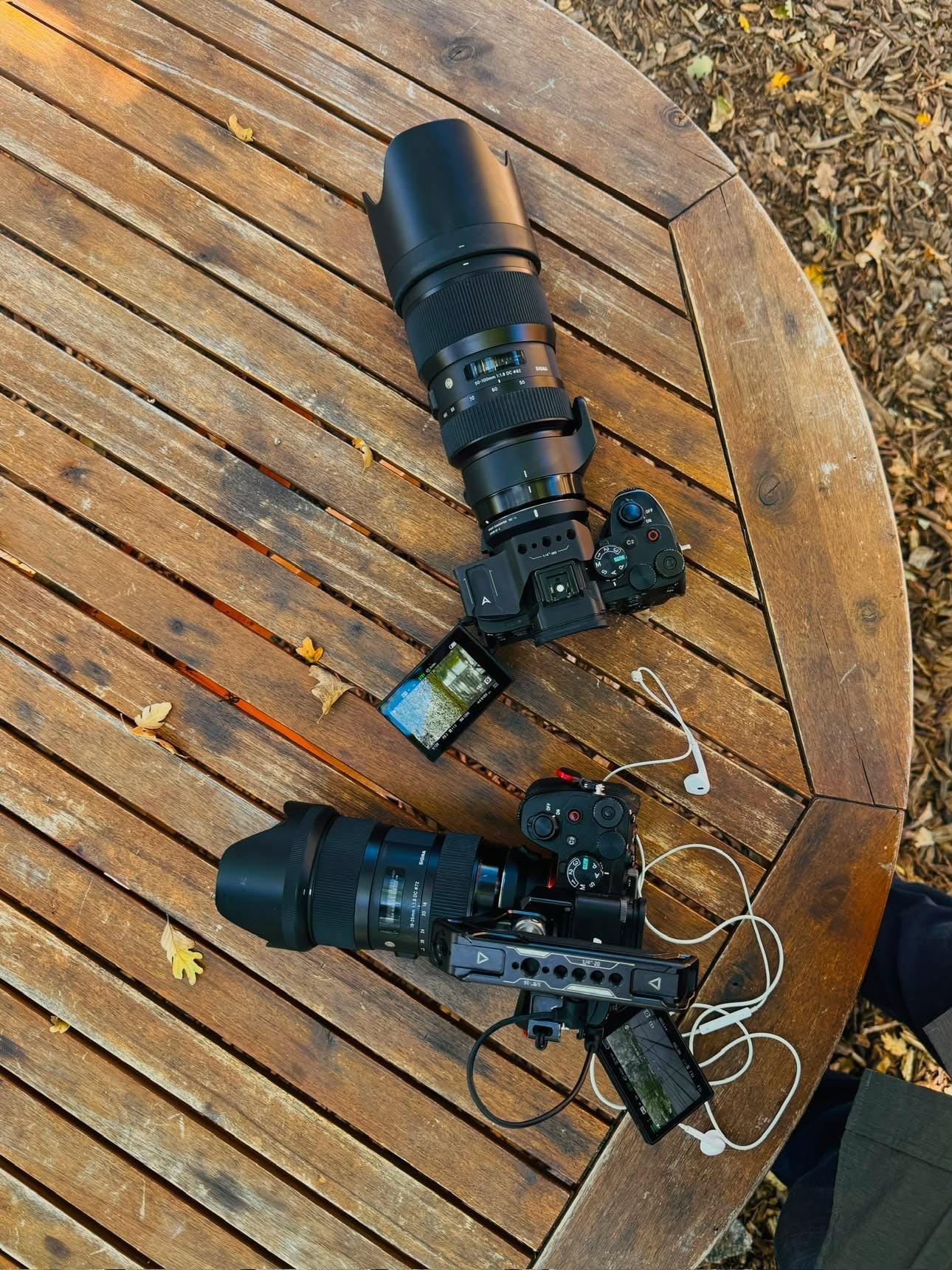
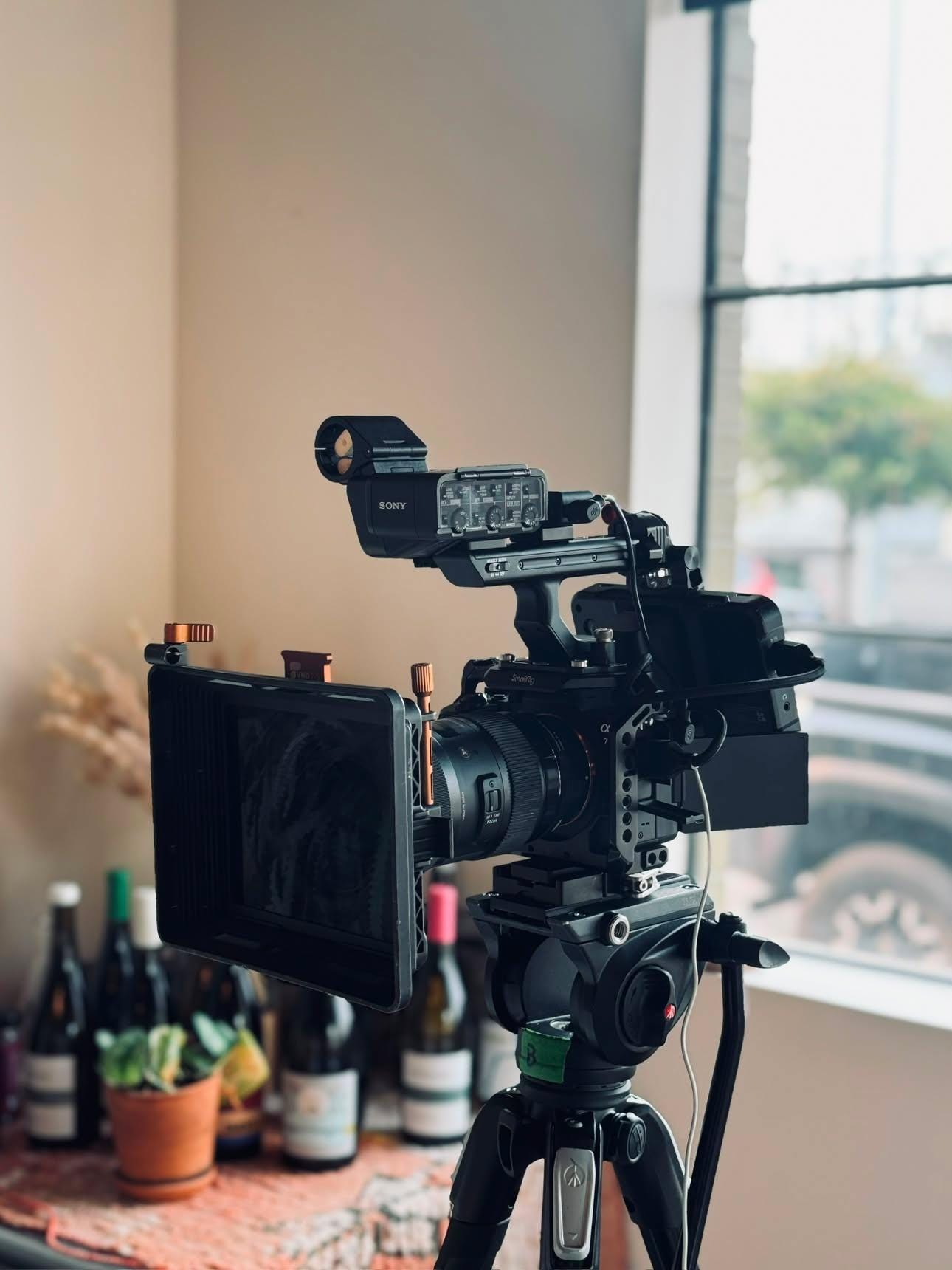
Juanjo travels with two high-performance Sony cameras, two lenses, and one backpack. That’s it. The basics. The fundamentals. Nothing about him announces what he is capable of. From a distance, he looks like either a really good tourist or an amateur videographer who spent too much money on his hobby.
Then you watch him work.
By the end, when you see the images, you start wondering where the five equipment cases were. Where was the cart? The extra lenses? The small army most crews seem to need just to cross a room?
Not with this man.
With Juanjo, the entire production fits on his back.
Then we drove north.
By Wednesday afternoon, we were in Sonoma collecting as much as we could. B-roll, road footage, improvised scenes, the small things you don’t know you need until you are standing there looking at them.
Thursday morning, we started at Ryme. From there we went to Scribe, then made our way over to Jolie-Laide to spend time with Jenny Schulz.
Interviews. Conversations. More B-roll. Watching the episode slowly reveal itself while watching Juanjo work. Again, not to keep talking about his greatness… but man, this dude is not only a humble creative magician. He is also a proud tactician who sees the image before the rest of us understand there is an image there at all.
A side note: you should follow his Instagram. His photographs, the way he captures people, objects, light, the parts of a room most of us would walk right past—it is one of the more special things you will find on social media.
The next day we woke up early, grabbed some missing footage, and by Friday afternoon, we were back in Portland.
Three days of travel, interviews, wineries, rental-car purgatory, improvised scenes, hundreds of shots, and Juanjo crossing half of Mexico and a piece of California.
All of it to make a thirty-minute show.


The week before.
Saturday morning, like always, I woke up, drove to the Saturday market, walked the path, and worked my list.
The days have gotten easier lately. Since the Wednesday Shemanski Park market opened up, everything feels a little lighter. You’ve heard me talk about the bags. IKEA bags, individual bags, all of it separated. The tougher bags keep things apart so the tomatoes and the soft things don’t get smushed. I never compress. I never stack. There’s an order to everything.
So I walk, and I complain to myself about the fucking push trucks.
Now, the young chefs love rolling these things around.
And don’t get me wrong: older folks get a pass. You need a pushcart, you get a pushcart. No questions asked. You’ve earned wheels.
But if you’re one of these young chefs—and you know exactly who you are—somebody is eventually going to forward you this letter, so let me save us both some time: I hate your guts.
I’m sure you’re a lovely person. I’m sure you’re a better chef than I am. Probably much better. And the fact that you care about seasonality, that you wake up early to inspect radishes and argue with yourself over the perfect tomato, genuinely brings me joy.
But I like I’ve already stated, I hate your guts, mostly because I hate your stupid truck.
Those trucks are the devil’s luggage. They block everything. They swallow entire aisles. I’ve watched elderly people disappear behind them and briefly wondered whether I had just witnessed a farmers-market manslaughter.
And there you are, captain of your little vegetable push truck, taking up an entire row as it stands next to you, carefully separating tomatoes, inspecting radishes like they’re diamonds, eyes closed -sniffing vegetables that really… do not need to be sniffed, taking your sweet ass time in a row already too tight for three normal people trying to shop with dignity.
Keep the truck on the side.
That’s all I’m asking.
Park it. Walk in. Choose your vegetables like a human being.
Anyway. Where was I.
I went to the market, picked up my things, dodged a few trucks, watched a few old people almost fall over, and headed back. Got to the restaurant, where Manny was already playing the new Strokes album… I’ll save that commentary for another time. I emptied the bags, broke down produce, put it all away, and brewed my team a pour over each. Six of us, six pour overs. Sounds like a lot. It isn’t. One scale, lots of precision, lots of experience, six minutes start to finish. Beautiful coffee all around. That’s how our morning starts.
From there people ask if there’s changes to the weekend menu. I talked it over with Chef Hanna Ruth. She said, I don’t think I’m ready. I looked at her.
She is the driving force behind República. People forget.
One of the most underrated chefs in this town. Her time in Europe, in Spain, in Michelin kitchens, gives her that. And she is somehow both the most skilled and the most humble person in the room. I don’t think she’s hit her peak yet, and that’s not a knock, that’s a promise. Because once in a while she surprises me. She surprises all of us. This team, early on, they wondered what this white girl was going to bring to it. Then they watched her attack wherever she can get her questions answered; a conversation with the people who knew the food, a cookbook, a YouTube video, some piece somebody wrote thirty years ago, whatever it takes, and they understood. Trust that Chef Hanna Ruth is learning. She got everybody to believe. Chef Olvia believed. I believed. That was Saturday.
Sunday is always fun, in the way a car crash is fun if you walk away from it. You know you’re going to get destroyed at some point. If you’re lucky it spreads out and never feels like a wall. If you’re not, everybody walks in at 11:30 and it doesn’t let up until two. You flip the front of the dining room twice, three times, and you keep going. We’ve gotten really good at being compact. It no longer feels like I’ve had two men sent off in the middle of a match and I’m playing eight back with one keeper.
Man, sports analogies are the fucking worst. Let me start over.
I feel like I’m always in control here now. It took a while. Everybody knows their role. One person handle the guests. The other handles the cocktails and the check and making sure people are taken care of on the way out. I’ll run every dish myself if I have to, and most of the time I don’t have to, because between the two women in my kitchen, Chef Hanna Ruth and Doña Geo, and Joselito flipping tables fast and not sitting on his hands in the back waiting on dishes anymore, and Jose at the comal keeping a running count in his head, we move. People don’t realize the comal is math. You pre-weigh the masa, every ball the same, and your tortillas come out consistent. Press too hard and the tortillas come out a different size and a different texture. It takes the right strength to get four the same weight and size, the same pressure, at a time. No machine. Pure manual labor. By Sunday we’re done.
I sit and look at all the work I still have through TODOS. I have to get Monday ready. We work Tuesday through Saturday at the restaurant, but the office never really closes.
Funny. It never ended.
The week after.
Monday. Manny’s in, Mau’s in, Juanjo’s in, Katrina’s in. There I am. I walk Mau through everything we shot in Sonoma, all of it already broken into a script, scene by scene, line by line, the footage separated and boxed so all he has to do is assemble. I tell him it’s a thirty-minute episode and I think we get it done in two weeks. Immediately he tells me it’s impossible. It won’t be good. There’s no way to give feedback, the voiceovers aren’t done. I let him finish. Then I tell him that before we left Sonoma I wrote the entire thing, and I had Kelsey Glasser record every voiceover we’d need. If we need her again, she’ll come in. The major work is done.
I can’t fully explain what this feels like. The closest I’ve got is a prefab house. Every screw counted, every nail, every board, mapped step by step. Production, when you get good at it, is still art. It never stops being art. But once you’re as good at it as we’ve gotten, it also becomes process. Systems. And you learn to trust that the creativity doesn’t vanish inside the system. The storytelling still shines. You just stop being afraid it won’t.
Then Katrina and I go over Between Courses. What are the stories, what did you eat this week, what do we run. She gives us her strong and unprintable opinions about the new bagel spot, one of the funniest conversations we’ve had, and almost none of it will ever see paper. That’s the tax. The best stuff dies in the studio while we’re talking shit, and then we move on. I hand Manny his two pieces. One on Guastavo, one on identity. You’ll find his work under Emmanuel Medina. That’s my brother. Little by little he’s finding the nerve to write in his own voice instead of sounding like every other writer in this town. Your own conviction. Your own struggle. Your own cadence. He goes back to work. Deadlines set. Then Juanjo and I start mapping the fourth episode of Humble Kitchen, the one we decided to shoot last minute because we couldn’t use the one we originally filmed. Not yet, at least.
Monday night was long. Production bible, shot list, scene list, interview questions, the list of people to interview. By Tuesday morning I had the team in and Katrina started booking them one by one. Eight people, including Chef Juan Gomez twice. The light interview first, the easy stuff, the lighthearted stuff. Then the dark interview. The set changes. The mood changes. It gets heavier, and that’s where the meat is. That’s the part that’s going to make you love him, or pity him, or leave you honestly unsure how you feel about the man. If we do it right, you’ll feel something. That’s the whole job.
Then three days of production, production, production. Mau moving faster than he believed he could, building his little boxes, scene after scene, believing a little more each day. It’s complicated. I’ll save it for the TED Talk I’ll give the day I win something again. Katrina appears frustrated about the process, she wants to spend more time asking follow up question during the interviews, I told her its not necessary… She says “okay… still don’t follow this logic”. I pause, I look at her and simply say “Wax on, wax off. Wax on. Wax off.” By now she is more confused.
What can I say to her, for now you just have to trust me, the way you trust a coach who’s playing two men down and still moving the pieces.
Ah, fuck. Here we go again. Anyway.
Interviews, interviews, interviews. And somewhere in those days I stopped taking breaks. I didn’t drink enough water. Every day there was red meat, red meat, a charcuterie board, another charcuterie board, more red meat. By Thursday I didn’t feel right.
It started as an ache. The side of my foot. Then the leg. Then the joints. But Thursday was the first day filming the restaurant, so I worked. A family eating, reaching for the food, the ambiance, the plates lit one at a time. By the end of it my whole right side was on fire and I couldn’t tell you why. Did I hurt myself again running up and down the Broadway Bridge stairs? Seven stories. You run it three times, that’s twenty-one. Maybe I went too hard. Maybe I hadn’t rested. Next morning it was worse.
Friday it was hard to get out of bed. I went to service anyway. I don’t know how I finished, but when I did I ran home and put my leg up and still couldn’t name what I’d done wrong. Two hours of rest before the next production day, the busy one. The kitchen. The chaos. The couple. B-roll and quotes from the chef in the middle of it. And by then every interview was in, which meant I finally had real lines to work with, and I could turn all of it into a living script, shot by shot. Complicated. Another time. The point is we did it. Friday night, in pain, leg up, I came back to the office and kept writing.
Saturday, the week after, I could barely stand up. But it was market day. I kept it light, thank God. Chef Hanna Ruth had pre-ordered most of it, so I just grabbed the boxes and went. Said hi to a few friends. Stopped at Sunrise Organics to remind them we’d be shooting the week after, which was hard to believe given how I felt, but I knew that come Monday I’d be walking the farm with Juanjo anyway. Back to service. More pain. And I couldn’t cancel, because months earlier I’d agreed to cook a dinner for Pickathon. One hundred guests, individually plated.
I got through service and went home to lie down, and that’s when it landed. Early that morning I finally understood what it was.
Gout. Fucking gout.
The illness of kings, I think they call it. Disease? I don’t know. I started counting up all that red meat. All the water I didn’t drink. All the rest I skipped. The purines just quietly building an empire inside me while I built one outside. Uric acid everywhere. So I overloaded on the only cure I’d accept. Cherry season, thank God. Cherry extract, celery extract, give me all the fucking extract, I am not taking pills. Probably stupid. Don’t judge me. I decided to let nature do its thing.
Saturday afternoon we fed a hundred people; 3 courses, 100 plates each course. The volunteers were a godsend. I went table to table, ten at a time, and told everyone exactly what they were eating, because that’s part of it. Maybe not the experience they thought they’d bought. But they were going to have my experience, the way we do it at República. Aguachile with fermented peaches and fresno on top, chile de agua in the base fermented with guajillo, a lot of citrus, marigold to finish. Then carnitas de puerco; pork confit, beans, a tlacoyo with beans folded inside, more flowers, a little salsa, purslane to pull it together. Then flan with figs, from my friend Fred Sanchez at Agua del Sol, who’d dropped off a mountain of them two days before. The volunteers cut them, plated them. And when it was done I was wrecked, but everyone was fed.
If you’re a chef and you do these events, hear me. Take care of your volunteers. Even before yourself. They’ll remember it, because almost nobody else does. I know that.
Sunday I was empty. The fish we’d hauled in the car had leaked, and the whole thing smelled like a fish market left in the sun. The sky was going yellow. It was hot but it felt like fall, none of it made sense, and we did service anyway. By one I couldn’t take it. The cherries, the celery, all of it working and not working at the same time. More water. More water. I know there’s a faster way. I let nature keep at it.


This week.
Monday we shot the farm. Chef Juan comes to Sunrise Organics, Paolo Martinez and his family, out of Putla, Oaxaca, here twenty-eight years. Him and his brother, the patriarchs. They’re a name now. His face is on a bus somewhere. And they grow some of the best produce in this town. I won’t say the best, there are too many good ones, but when I’m around that family it feels like my own. We filmed about an hour we’ll cut down to three minutes, and they fed us the whole time. Corn straight from the milpa, cut that morning, so sweet you took a bite and got emotional. Chile rellenos I inhaled. I took home tomatoes; six varietals, serranos, poblanos, jalapeños,cherry bombs, nardellos, eggplant, squash, cucumber, and lots of corn…. basically, whatever was in the ground. Drove back to Portland with the sky still yellow and put it all in the fridge.
Tuesday we screened the pre-cut draft of Her Way, Episode Two, then I brought everyone together for feedback.
Everybody had something to say. Questions. Notes. Knee-jerk reactions. The usual. That is part of working in a creative space: everybody has an opinion, and even when your first instinct is to tell them to fuck off, there is usually a reason they feel the way they do.
Usually.
This was one of those moments where I felt good about the writing. Good enough that I caught myself defending it, trying to explain the difference between the way everybody else writes and the way we write. The way I write. It is not supposed to sound like everybody else. That does not necessarily make it original. It only makes it mine. The shows should feel like they are ours; our voice, our writing, our style of cinematography.
We went back and forth. Eventually, we knew what needed to change. Then we ate lunch and went out to shoot another episode of Her Way, because apparently finishing one television show before starting the next is for people with boundaries.
This time we went to Division Winemaking Company to meet Kate Norris.
Kate is an incredible winemaker, but more than that, she is one of those genuinely rare human beings: kind, interesting, curious, funny, the sort of person who makes two hours disappear before you realize you have been working the entire time.We filmed the interview, walked the production space, and finished with a full break of the fourth wall, which has slowly become one of the signatures of the show.
Normally, shooting outside is difficult. That afternoon, the sky did the lighting for us. Everything had this strange yellow glow from the smoke, the fires, the heat, global warming—take your pick. It felt deeply wrong and looked absolutely beautiful, which is probably the most accurate description of the world right now.
That was Tuesday night.
Another seven-minute segment. Maybe eight. Maybe ten.
All in a day’s work.
Today came. The assignment was simple: finish Her Way.
Add the credits. Make the changes. Watch it again.
We did.
Then we went back and made more changes, because there is no such thing as a final cut. There is only the cut you eventually agree to stop touching. Color correction. Replacing images. Adjusting frames. Normalizing the volume. Making sure the same shot does not appear twice. Catching the little things you only notice after watching the same thirty minutes over and over and over, until you no longer know whether something is wrong or whether you have simply stared at it too long.
Eventually, every change was made.
The show we began filming—not this week, not the week before, but the week before that—was done.
Then we moved on to Humble Kitchen and the beginning of that beast.
That is what the work looks like. That is the beauty of it. You begin in one place and, by the time you are finished, you are somewhere entirely different from where you started.
That might sound more existential than poetic. But when you are getting better, even a quarter of a percent every day, it accumulates. By the end of the week, it means something.
So that was the week.
Now you know my chaos.
Organized chaos.
Today, after this piece is done and after our newsletter goes out I will -rest. Three hours to myself, which is the most I know how to give. My friend is coming by the bar to say hello and have a drink, and I’ll have to tell him I’m not drinking right now. Gout got a vote, finally. But I’ll pour him something, and I’ll pour myself an NA spirit, and we’ll sit there like the body didn’t just win an argument I’ve been losing all month.
Tomorrow, the menu special.
Then again, it always is.
Nos vemos el jueves.


All photography in this essay was done by Juan Jose Sanchez