


Preface: the accenting of certain Vietnamese words are omitted due to character limitations on my keyboard
I hate to use this phrase because it sounds so cliche, and that’s when there’s an experience that “transports you.” I see this phrase used often in a travel context, a food experience, and in the case of Portland, it’s often both — someone’s restaurant or pop-up “transports patrons” to a place other than this city.
It sounds lazy, like a throwaway phrase that you can plug and insert into any experience that doesn’t feel oppositely “so Portland.”


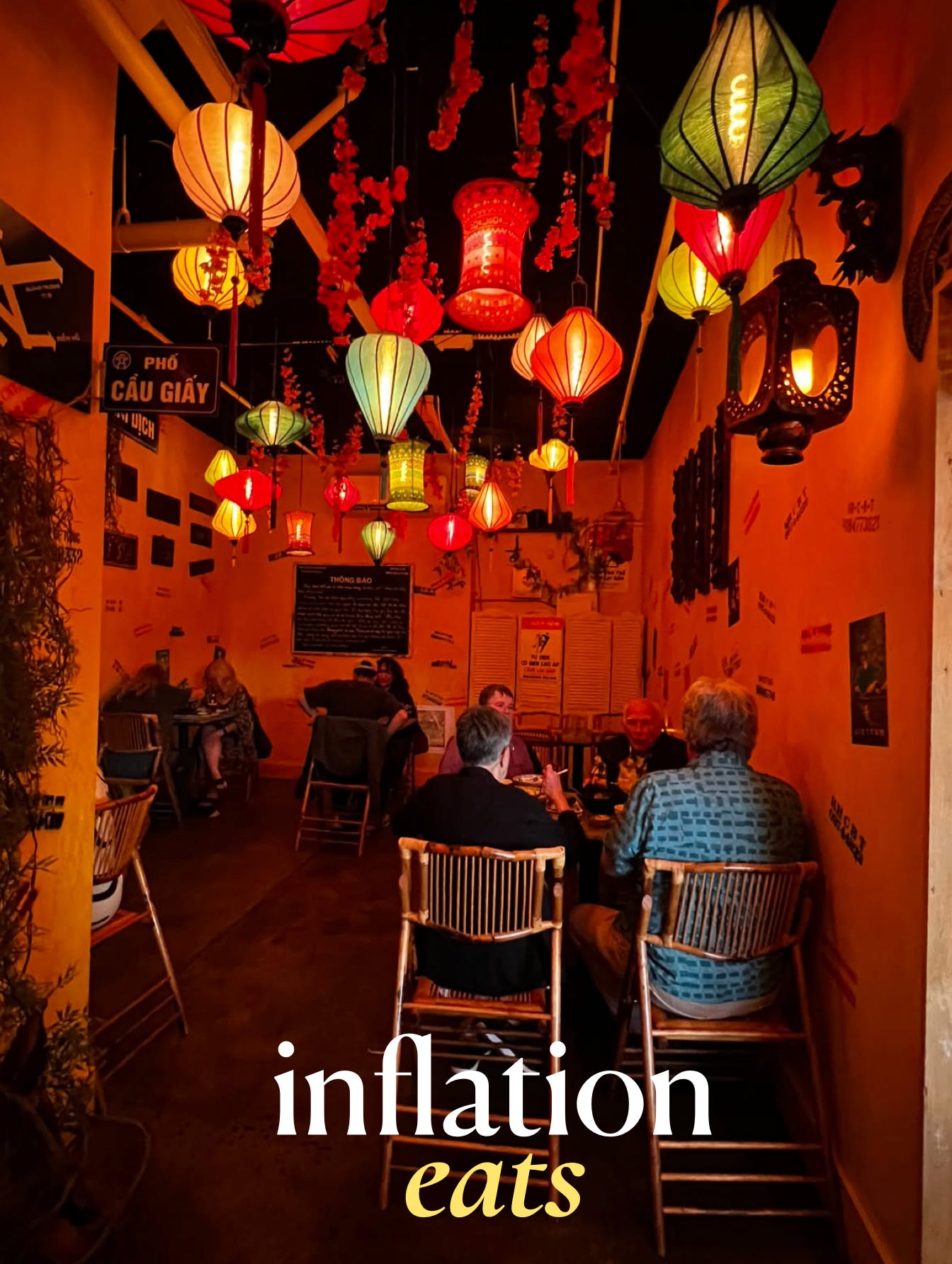
And yet, I couldn’t help but feel some sort of sad, wistful nostalgia while I sat at a tiny plastic table at The Paper Bridge eating a bowl of noodles; I remember sweating into my soup, aware that it was almost 90 degrees outside of this northern Vietnamese restaurant that everyone has been talking about for months. Surrounded by multi-color lanterns and faded parchment paper-textured walls shrouded in dim lighting, the experience didn’t feel too dissimilar from the weeks I spent eating alone in humid, crowded corners of Hanoi and Hoi An. I recalled these moments from my past while I ate at The Paper Bridge as if they were flashbacks; their uncanny similarities to my present confused me emotionally in a way that made me yearn to go back and repeat those memories—but with more conviction and assurance that wherever I was going in life at that time would be forward.
So when someone says that an experience transported them, I’ll try to give them some grace. If a place, experience, or event is able to give someone their own unique version of transportation the way I did, I think it deserves validation.
There was, however, one major contrast between eating a bowl of noodles in Vietnam versus eating a bowl of noodles in the United States—besides the price, of course, since Vietnam is well known to Western travelers as a budget-friendly destination. And that’s the fact that the bowl was double the size of the portion it would have been in Vietnam.


And yet, I felt that financially, a large bowl of noodles was the only thing I could order as a solo diner because everything else was a small or shareable item that ranged $10-20/plate.
Something that I knew going into The Paper Bridge was that it was not going to be very solo dining friendly. I told myself that I was going to try to spend less than $35 eating out this time. If I gave myself an average budget for how much I would like to spend in general when I ate out, that budget would be less than $25. So far, I’ve only been able to manage that amount once, which was at Guay Tiew (and just barely at Pipsqueak Bagels). By the time I arrived to The Paper Bridge, I wanted to be very intentional about limiting myself to a certain dollar amount and staying within a budget, rather than seeing how much I would end up spending at a place to be full.
That being said, while The Paper Bridge had an impressively massive menu of small-plate dishes with detailed descriptions of their historical context, I had to pass on most of them because they ranged $10-20 ($30 at the most for some beef skewers). Buying 2 small-plate dishes with drinks that ranged between $7-15 (even the non-alcoholic ones) would have probably left me feeling hungry and easily going over $35. After spending a good 20 minutes looking through the menu, the noodle entreés felt the most solo diner-friendly to me. I picked the bún cá Mai Dich, a type of regional noodle fish soup with tangy broth, which cost $22. Expensive, but pretty comparable to how much other phó shops in Portland are charging for their dishes nowadays.


As expected, the soup was fantastic. The portion was not massive but also not disappointing, and there was enough fish in the dish that I felt like I was getting my money’s worth on seafood. It was actually surprising to me that a fish dish cost the same amount as their most popular noodle dish, the bún cha Ha Noi, which is pork-based.
I also ordered a nuoc trai cay, which was labeled as a Vietnamese street café drink. The chanh mo xi muoi was a drink with salted lime, apricot, pineapple, and calamansi soda, and cost $8 — Which I thought was a little steep in price but if you placed it in the “mocktail” category, it would also fall within the standard range that Portland restaurants charge for these drinks nowadays.
Overall, after a %20 tip, I spent $36 on an entrée and a drink. Just $1 over my internal limit.
The staff was nice in a way that didn’t feel performative or overly nice. I don’t know how to explain it, but as someone else who works in hospitality, it can be kind of clear to me when someone has that kind of insincere “customer service” personality on. They came often to check on me, and were patient with me when I spent what felt like ages reading through some of the historical descriptions with menu items — I have a feeling they’re used to this.
So while I was satisfied with the dish I ordered (not that impressed by the drink), I recognize that I failed to enjoy the restaurant the way it was meant to be enjoyed—and that’s through family-style eating, what my friends and I would just call Asian-style eating.

Family style has always had more pros than cons to me. You get to try a wider range of dishes, the price ends up being a little more affordable, and it’s simply a more fun and interactive form of dining — Look at hot pot and Korean barbecue, for example. Those are two of the most formalized family-style eating experiences and they’re both Asian cuisines.
In this moment, however, I experienced both the financial consequences and limited range of this style as a solo diner. It reminded me of connecting with another solo traveler during that same trip I had mentioned earlier, when we were both on a group tour in Taipei. Although we both went to Korea, where I visited with a friend, he didn’t get to experience half of the food that I did because he visited as a solo traveler. He told me that in Seoul, he would be sometimes turned away as a solo diner by certain restaurants because their foods only came in massive quantities that had to be shared—some dishes that come to mind were dak-galbi and budae jjigae.
With that being said, I wish I had come to The Paper Bridge with friends. However, I certainly think it’s still worth a visit if you go with a group.
Portland is blessed with a wide variety of Vietnamese restaurants specializing in lesser-known regional specialties. We’re very lucky to know that it’s easy to eat something other than phó, bánh mi, or bún at a Vietnamese restaurant here. I love how The Paper Bridge continues to add something to the mix that none of the other Vietnamese eateries are doing in a way that doesn’t necessarily take away their patrons; rather, it enhances the overall scene and range of options and styles in the city.
Service: 5/5
Food: 4.5/5 (-.5 for the drink)
Value: 3/5
Atmosphere: 5/5

Hi Katrina! Thanks for a nice chat the other day. My wife and I tried to book a table. No reservations. Trying again next weekend.