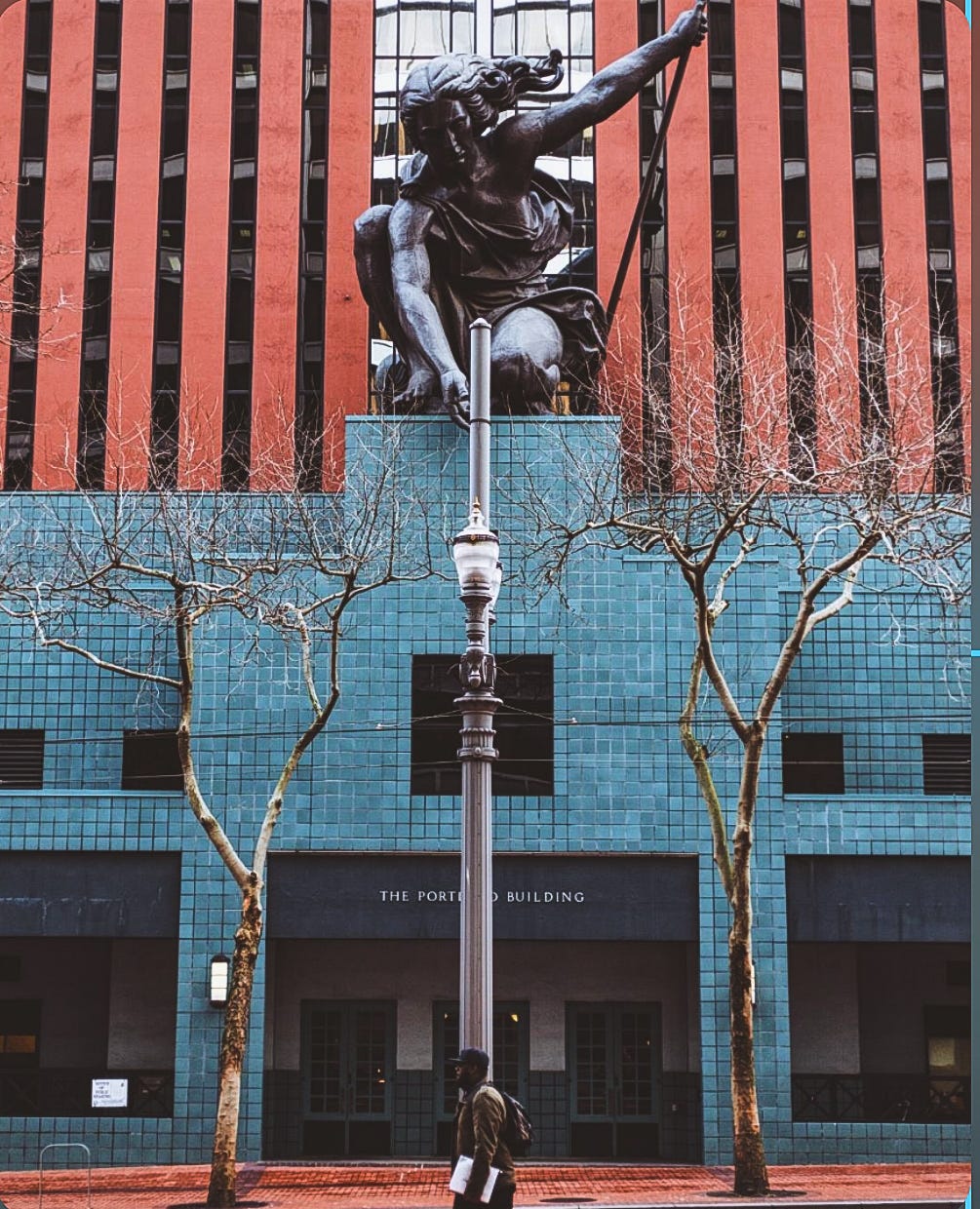
On Southwest Fifth Avenue, 1120, there’s a moment — if you slow down — when the city reveals itself in copper.
It happens in the late afternoon, when the light slips between the buildings and catches the façade of the Portland Building just right. The pastel geometry softens. The sky turns silver. And three stories above the west entrance, kneeling against the wall as if in quiet conversation with the street, there she is:
Portlandia.
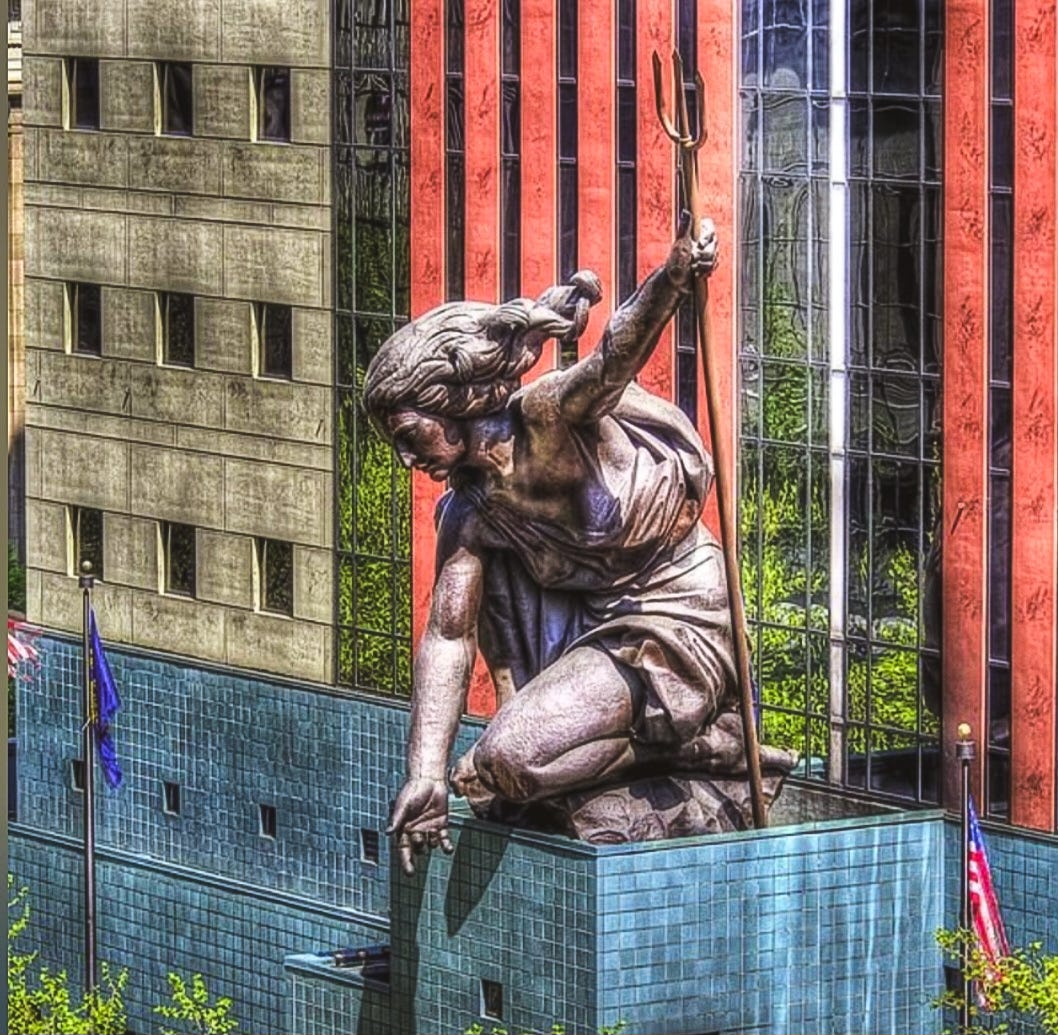
Thirty-five feet of hammered copper. Six and a half tons of patient craftsmanship. A trident resting steady in her left hand. Her right palm extended — not downward in surrender, but outward, as if balancing something invisible between herself and the city below.
She does not tower. She does not conquer. She kneels.
I came to Portland in the summer of 2010 and I fell for it the way you fall for a person — fast, completely, without a good reason you could explain to anyone else. The foot traffic on Fifth Avenue. The food carts materializing out of nowhere. The way strangers made eye contact and meant it. It felt like a city that had figured out something the rest of America hadn’t yet — that you could build something livable, human-scaled, weird, and proud all at once.
I didn’t know then how much I would need that version of Portland to survive the one that came after.
I’ve walked past Portlandia more times than I can count without really looking up. That’s the thing about grief — it works the same way. You move through it without looking directly at it until one afternoon the light catches something and you stop.
She was born from a radical civic idea: that public buildings should carry art within them. That culture was not decoration, but infrastructure. In 1975, Portland passed its One Percent for Art ordinance, setting aside a portion of public construction budgets for artwork embedded in daily life. Not reserved for museums or private collections. Not optional. Built in.
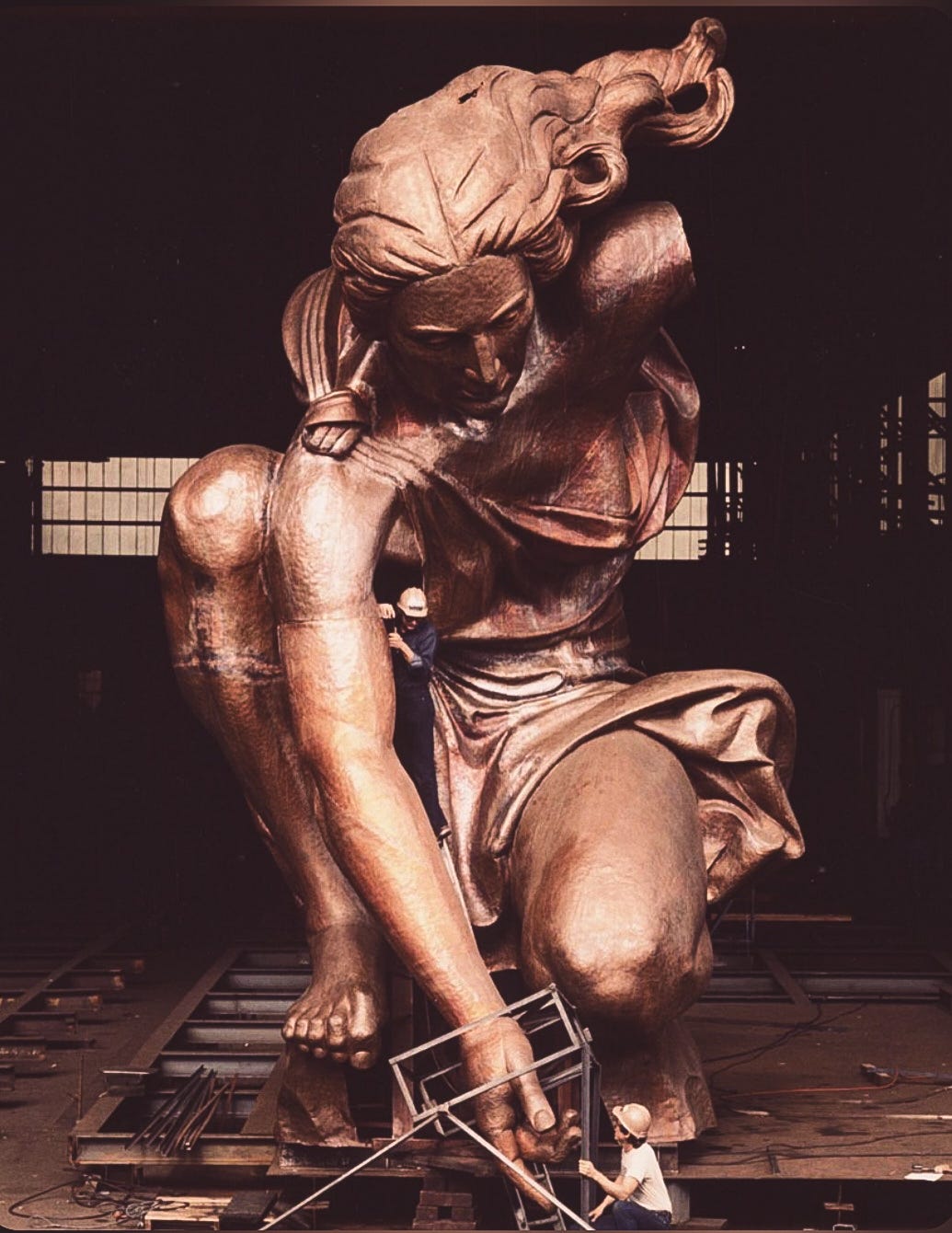
Architect Michael Graves understood this. He didn’t want sculpture politely sitting in front of architecture. He wanted art as architecture — inseparable, structural. So Raymond Kaskey shaped Portlandia from thin sheets of copper using repoussé, an ancient hammering technique that asks for patience rather than force. Every curve formed slowly. Every contour pushed into existence from behind.
Monument made from fragility.
And maybe that’s why she feels so human.
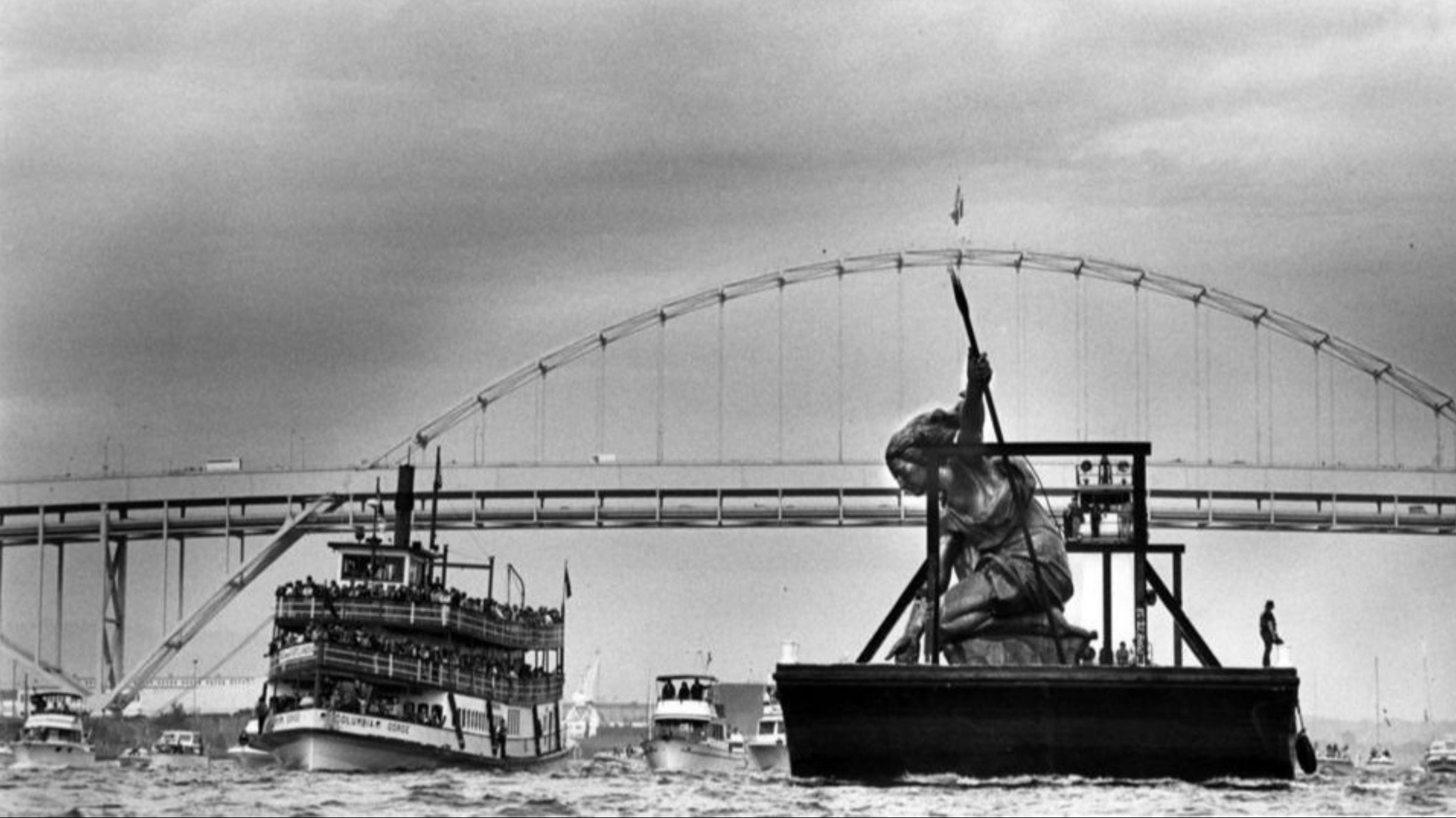
She was fabricated in Maryland, then shipped west and floated up the Willamette River before finally being raised into place above Fifth Avenue. A copper figure arriving by water into a city shaped by rivers, trade, rain, bridges, and movement.
You have to look up to find her.
These days, looking up is an act of will. The blocks around her are not what they were. The foot traffic that made this city feel alive — the cart pods and the lunch crowds and the ambient noise of a city that wanted to be outside — has thinned in ways that still catch me off guard. There are mornings on Fifth Avenue when the silence feels less like peace and more like absence. When the empty storefronts and the people sleeping in doorways and the particular exhaustion on the faces of those still trying — still showing up, still opening their doors — makes me wonder what we’re preserving and for whom.
I don’t say this to be bleak. I say it because I love this city and love requires honesty.
In winter, rain darkens Portlandia’s surface. In summer, light turns her almost golden. She seems less like a statue and more like part of the atmosphere of downtown itself — something the weather works on, something that has watched the city below her change in ways that would break your heart if you let them.
She has seen Portland at its most alive. She is watching it now, through whatever this is.
In a world eager to flatten every symbol into branding, Portlandia remains particular. Her image is protected. Not diluted into merchandise, not stamped casually on bottles and tote bags. Some see restriction in that. I see stewardship. There’s a difference between a city that protects its symbols and a city that sells them — and underneath that difference is a question about what we actually believe is worth protecting.
When the Portland Building was reconstructed, engineers studied her carefully. Her copper skin — thin, stretched over an internal frame — could not be moved without risk. So they built scaffolding around her and protected her in place for more than a year.
They didn’t relocate her for convenience. They preserved her where she stood.
That matters more than it sounds. Because there is a version of this city’s future that decides the solution to injury is erasure — new everything, louder everything, tear down what isn’t working and replace it with something that performs better on paper. And I understand that impulse. I feel it sometimes myself. The frustration of watching something you love struggle and not knowing what to do with your hands.
But Portlandia was not moved. She was protected in place. Scaffolded. Held.
And she endured.
Portland changes constantly. Restaurants disappear. Neighborhoods shift. Entire versions of the city rise and go quiet. I have watched this one — the one I arrived to in 2010, the one that made me feel like I had finally found somewhere that made sense — take a series of blows it is still trying to recover from. The epidemic that camps on its corners. The commerce that left and hasn’t entirely come back. The grief of a city that believed in itself so publicly and then had to figure out what belief looks like when things get hard.
But Portlandia remains above Fifth Avenue, hand extended toward the street, her trident pointing toward the river she arrived on.
She is not a relic. She is a posture. A reminder that this city’s best instinct was never dominance — it was offering. Not a raised fist. An open hand.
I still believe in that Portland. The one that embedded art into policy. That funded culture with intention. That built beauty into the machinery of government because it believed beauty was not extra but essential.
That city is injured. It is not gone.
And some afternoons, when the light is right and I finally remember to look up, I can still see exactly what it was reaching for.