

Snap Pea Esquites
Portland’s “false spring” isn’t going anywhere this time, and the produce is benefitting from that.

Right now, at this moment in time, it’s too easy to say that this is my favorite season because everyone in Portland is feeling that way right now. Everything’s starting to move. There’s still that Portland mist, that rain, but blooms are starting to occur. It feels like the Earth is about to awaken.
Progressive spring is the epitome of hyper-seasonality
So I’ll be a little more specific and talk about the clash between the end of winter and the beginning of spring, the progressive spring—I love all the micro-seasons that come with produce during this time. It’s why I call Lilia Comedor hyper-seasonal—it’s because of this time in the spring, when I get to work with produce that has special, limited growing seasons. The green strawberries that our team used recently were one amazing example of that because they only grow for two weeks out of the year. Something like spruce tips, which is on this week’s dessert menu, are another prime example of that because they’re also only available for a couple weeks.
And not only are spruce tips hyper-seasonal. They’re super regional… I mean the food of the land, the food that was here before any of us were. Spruce tips are the food that was utilized by indigenous people who have been eating them for hundreds of years. They’re a great representation of these people and this region.
Snap peas and the farmers market swing
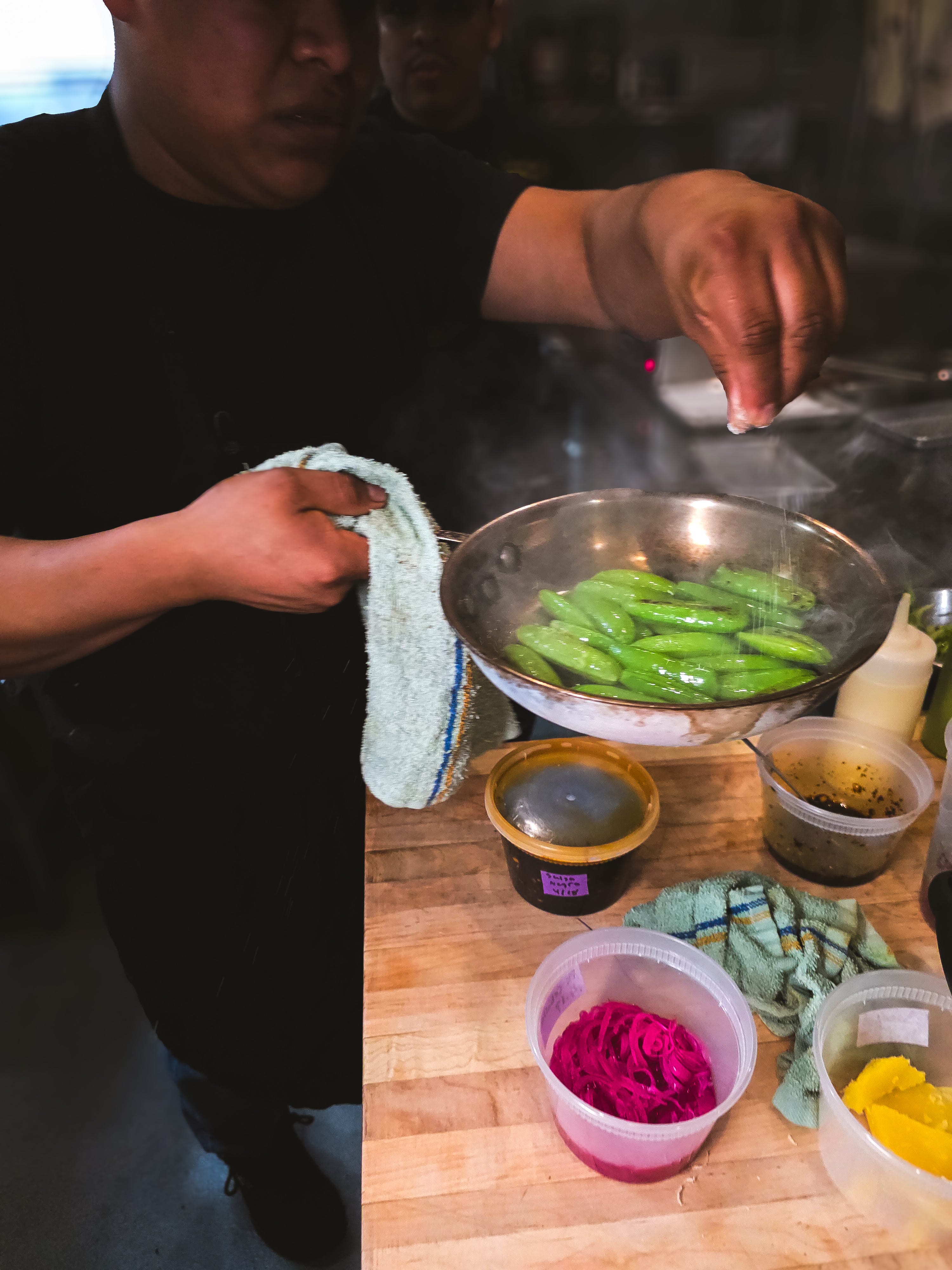
At the farmers market lately, everything has been flourishing. There’s a noticeable shift. When I’m deciding on what produce to use for Lilia, I usually let the produce talk to me. I gravitate towards whatever looks most beautiful (and let me just remind you that beauty is in the eyes of the beholder). This week, snap peas were one of those items.
The first time I saw that snap peas were available on Eloisa’s Instagram, I was running late to the farmers market and they were already out of stock by the time I got there. It’s not the end of the world to miss a vegetable’s first week of harvest though, because the micro-seasonality of vegetables can even change from the start of a cycle to an end. Sugars can develop, maturing roots will deepen a flavor, etc. For snap peas though, missing the first week is fine. Their sugars still haven’t fully developed, so they’re really crunchy and perfect for my dish this week, which is esquites.
Building esquites by starting with snap peas
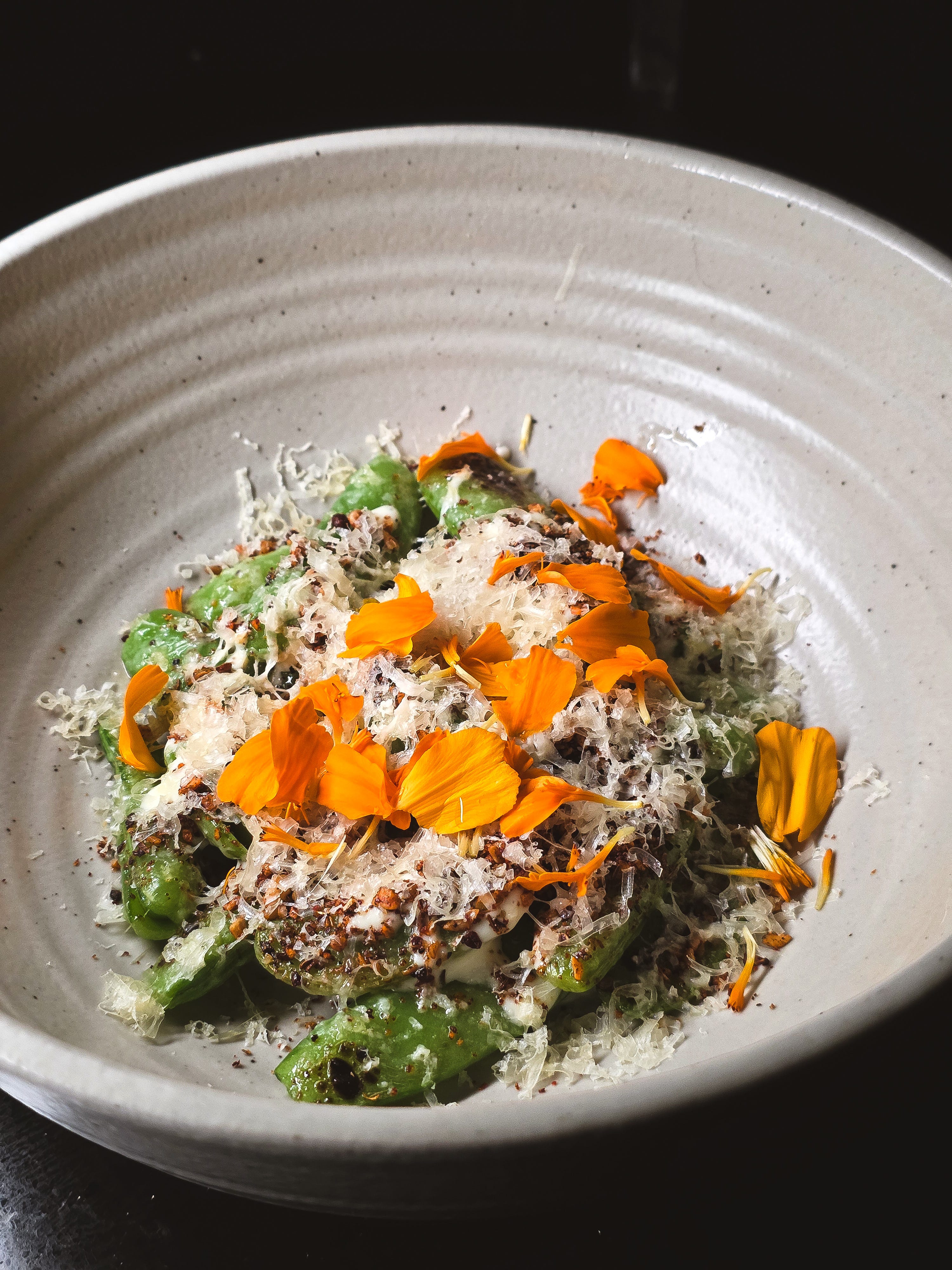
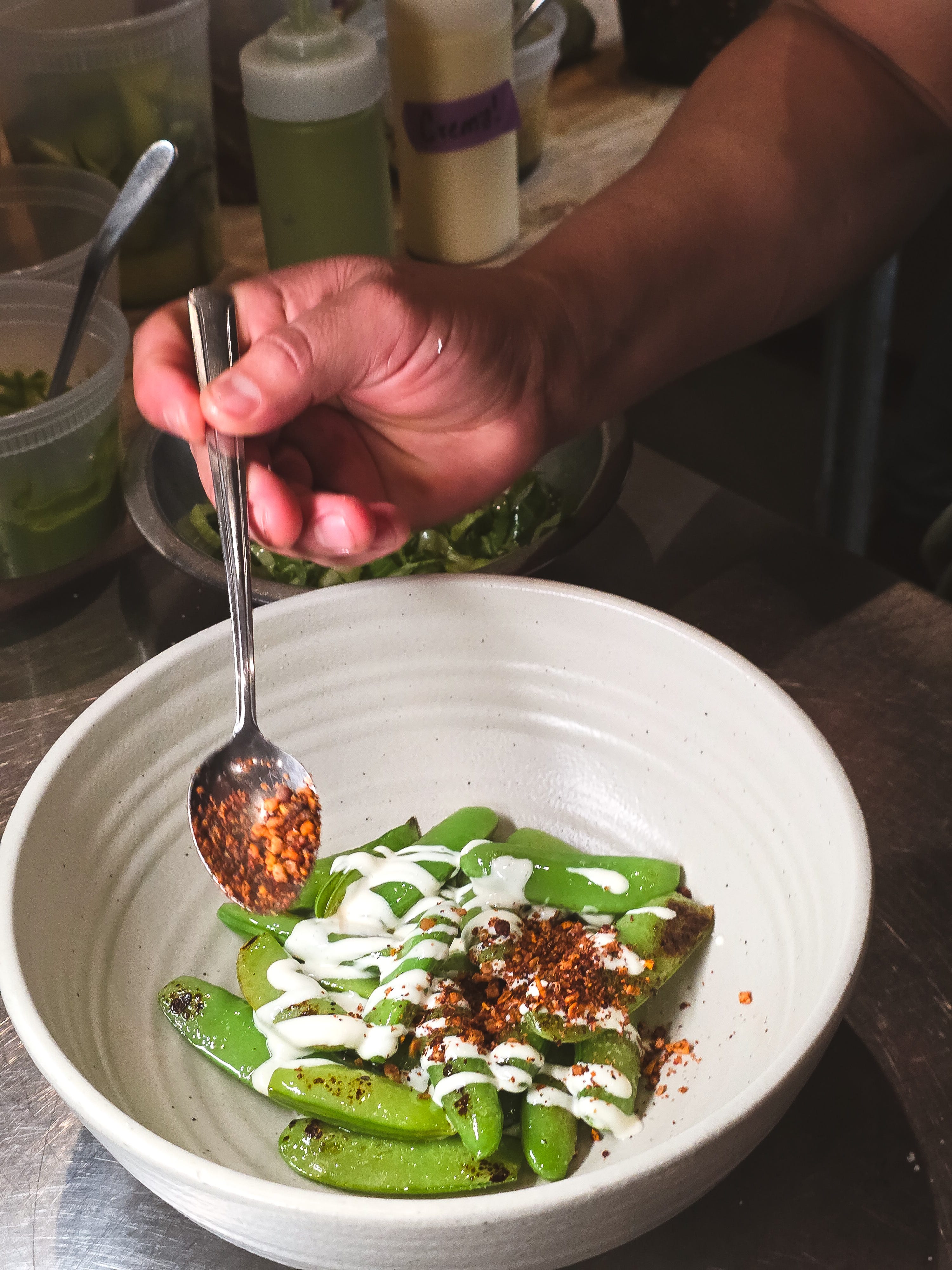
Esquites is a street food from Mexico that consists of loose corn kernels in a cup that get topped with mayo, Tajín, lime, and cotija cheese. But instead of using corn, we’re replacing it with whole snap peas, skin intact. Unlike English peas that you eat for the pods, you want to eat the shell of a snap pea because of that crunch it has; so, for that reason, we barely sear it for this dish before topping it with a roasted garlic and Meyer lemon aioli instead of mayo, the Meyer lemon representing the last of winter produce. It has a little more depth and gives this dish that fatty element that it needs.
Sunflower dukkah as a means of crunch and complexity
The chile powder we use is a dukkah with chiles and a lot of other powerful spices. Dukkah is a Middle Eastern spice blend that our team often makes in house with the ingredients that we have on hand, which allows us to be really intentional about the moment in time and what spices make the most sense seasonally and from a flavoring perspective. This week, amongst ingredients like pink and black peppercorns, several chiles, cumin, coriander, etc., it has sunflower seeds–which is another representation of ingredients available during the shift-over seasons. Of course they have a nutty taste, but they’re also bitter and sweet, and the texture of its crunch is something I just can’t compare to any other kind of seed or nut. This week’s dukkah really helps us elevate the esquites beyond a standard street food with a deeper level of complexity.
Adding funkiness with an apple cider-washed cow cheese
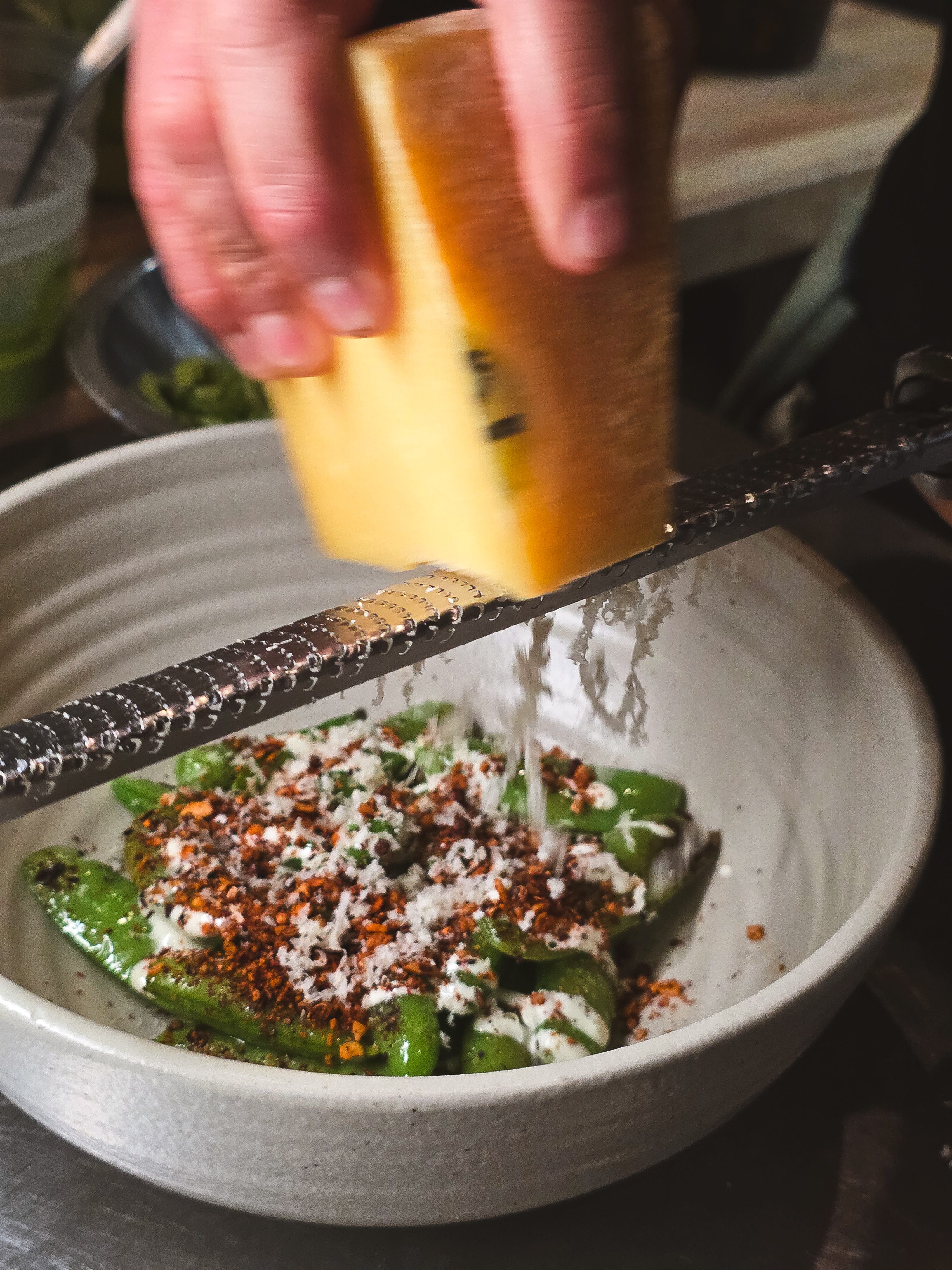
Another thing that really takes this dish to the next level is the alpine cheese. For this version of esquites, cotija cheese would have probably been too overpowering when we want the sweetness and the beauty of the snap peas to stand out the most. However, I still needed a cheese that was still a little sharper than a cow’s cheese but not as tangy as a goat’s cheese. So we’ve got an alpine gruyere cheese washed in apple cider from Helvetia Creamery, who only has about five cows a year to manufacture this. When I came upon it at Cowbell Creamery, I was looking for something that was a little bit more intense than Parmesan, but a little bit more reserved than a sheep’s cheese. This cheese really nails it, and the creaminess really completes this dish.
Who says esquites has to have corn in it?
If I closed my eyes and took a bite of the dish, I would just instantly know that this is definitely esquites. It doesn’t have to be made with corn or just mayonnaise, because that’s not what esquites is all about. I could definitely see where the dish is going, where it came from, and where it’s going to end up at.


 | A guest post by
|